We like country too. Yes, really. Well, sometimes. When it’s good. Because a lot of it isn’t. Then again, a lot of music in a lot of genres isn’t good. On the other hand, a lot of music in a lot of genres is good. Weird how that works.
Moving on.
We’re having a kanipshin after hearing the new project by Alex Maas of the Black Angels and self-described Heartless Bastard Erika Wennerstrom. It’s called Sweet Tea and sounds sweet as can be: Get converted by this touching live cover of Tim Harden’s “If I Were a Carpenter”:
If you’re even fairly familiar with raunchy comedy, “The Aristocrats,” an ever-evolving running joke so dirty that comics used to only tell it to each other behind closed doors, probably rings a bell. The jape varies in length, vulgarity, structure, plot and tone, depending on whichever comedian is telling their version of it. But baked into the joke are, unwaveringly, graphic scenes of a family engaging in scatological, sordid and smutty behavior during an audition in a misguided effort to win over an agent to book their stage act. And the punch line always remains the same, with the family revealing at the end of the audition that their stage name is “The Aristocrats.”
Louis C.K. and David Cross were roommates in the ’90s, so it’s not shocking that they came up with nearly the exact same bit on men with mustaches rollerblading in public with a sense of superiority to those they passed on the sidewalk.
From David Cross’ comedy album Shut Up, You Fucking Baby (2002):
From Louis C.K.’s first full-length broadcast special, Shameless (2007):
Today marks the 53rd anniversary of “Power to the People,” a performance by John Lennon and Yoko Ono’s Plastic Ono Band. As a nation, we are thirsting for our own contemporary music megastars (Taylor Swift, Beyoncé, Drake, Billie Eilish, Bad Bunny, etc.) to re-create such an event at a time even more perilous than when the peace activists of yore performed at Madison Square Garden in New York.
Side note: The whole “karma” concept that Lennon and Ono preached? Yeah, that’s proven to be a fallacy. No amount of suffering that could befall Donald Trump from here on out would be commensurate with the amount of damage he’s done to our country, which will take many decades to repair.
Fortunately, Lennon isn’t around to bear witness to the atrocities that are occurring every day in the U.S.
Check out these previous installments of The Bad Penny’s On Tyranny series:
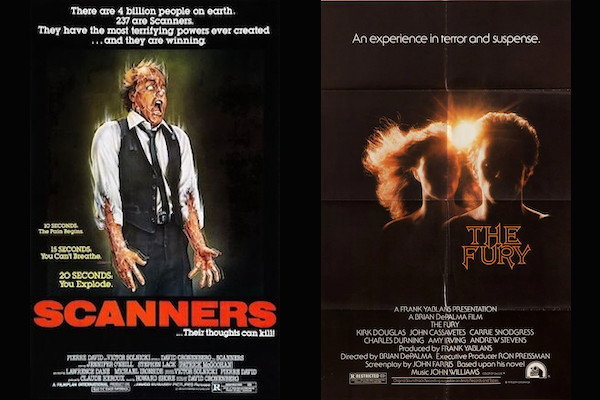
Can’t seem to find much discussion about this online, but does anyone else notice that David Cronenberg’s Scanners (1981) and Brian De Palma’s The Fury (1978) – both films that come very, very highly recommended – are virtually identical? Both movies revolve around young adults who possess telekinetic powers that can control people à la The Force from Star Wars. These outcasts keep their potentially threatening, manipulative abilities on the DL, find solace living in secret societies, and are hunted by malevolent thugs out to kill them.
The exploding cherry on top of this theory? How often do you see self-combustion sequences onscreen?
Scanners:
The Fury:
De Palma would be the obvious plagiaristic culprit here, as his 1981 John Travolta classic (not an oxymoron!), Blow-Out, copped copiously from Francis Ford Coppola’s The Conversation (1974) – two even greater masterpieces. ‘Cept The Fury came out three years before Scanners, which Cronenberg himself wrote.
Please share any insights if you got ’em, so long as they don’t cause anyone’s head to explode.
Say what you will about the new identity of punk rock and the renewing of marriage vows between punk rock and corporate enterprise, here are a few reminders about what still lies at the heart of the movement:
2. Engaging in pay-to-play schemes that pads the pockets of music venue owners and managers, magazine editors and publishers, agents and promoters and publicists, and other industry types who profit off musicians, is not punk rock.
3. Propagating, platforming or even permitting racism, sexism, homophobia, transphobia and all related forms of hate and discrimination is not punk rock.
4. Increasing one’s personal gain at the expense of punk-rock bands and fans, whether it be through inflated ticket prices, ad revenue largesse and opportunistic financial benefits is not punk rock.
5. Taking advantage of or profiting unjustly off sincere, well-intentioned and therefore often vulnerable people who support punk-rock ethics is not punk-rock.
The special 45th anniversary edition of The Big Takeover, one of the oldest and last-surviving punk-rock magazines, is now available here. The special issue features more contributions from yours truly than every before–and they’re exclusively featured in the magazine:
• a deep conversation with Michael Gira of Swans • my second feature with drummer Todd Trainer, stemming from the first interview he gave after the passing of his beloved Shellac bandmate Steve Albini • a dispatch from a “Fighting Oligarchy” event in Idaho that featured Built to Spill, Bernie Sanders and AOC (and drew national attention) • my reviews of new releases by Airport 77s, Dez Dare, Librarians With Hickeys, Mdou Moctar, mssv, Onsetter, Pleasure Pill, Plight, Royal Chant and Unstable Shapes
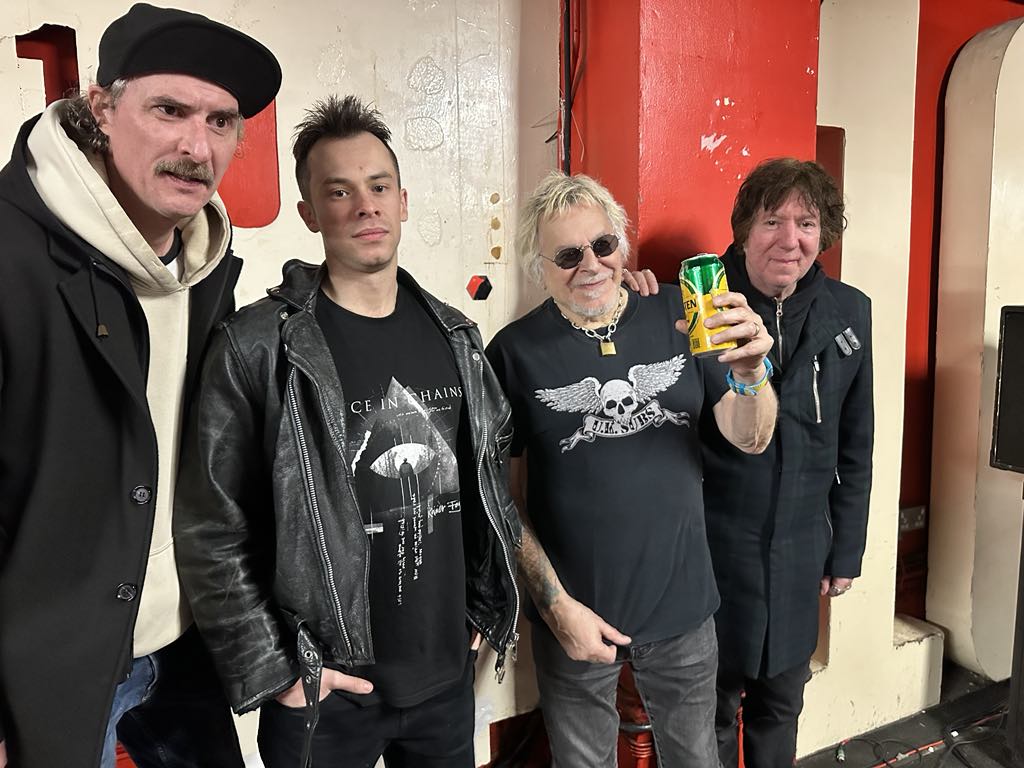
A new chapter in Trump’s war on free speech has apparently begun, withmembers of punk legends UK Subs denied entry into the U.S. and detained after traveling to play a concert Stateside, according to The Guardian. The U.K. news outlet cites accounts purportedly posted on the band’s Facebook page. (The Bad Penny does not utilize or endorse social media.)
There’s a very strong case to be made that so-called “dark rock” band Unto Others out of Portland is one the most exciting underground bands of the past 10 years. For those of us who hated the prevailing clean production style that dominated the 1980s, Unto Others have found a way to revisit that sound and plaster it with emotionally charged, melodically masterful licks.
But both articles neglected to underscore the writing acumen of Franco, the lyrical brilliance he injects into songs that are–yes, catchy as hell–but challenge the listeners attracted to them with easily overlooked wit.
Take “Pet Sematary,” a song that references the Stephen King novel of 1983 and, presumably, the schlocky, same-titled film that followed. For most heavy-rock bands, shouting out the story about a graveyard where the dead are reanimated would be sufficient to establish or reiterate their (often faux-) “dangerous” cred.
But Franco, as he does with his remarkably smart handle on songwriting, takes the metaphor a step further. Rather than suggesting he wouldn’t want to be brought back to life for the obvious reasons on paper–one’s skin would be falling off, they probably wouldn’t want to be seen in public, etc.–he takes it a step further. Instead, Franco posits that the reason he wouldn’t want to be buried in a so-called pet cemetery is because that would force him to live his miserable life all over again:
“I don’t wanna be buried in a pet sematary/ I don’t want to live my life again/ I don’t want to live my life/ Oh, not again/ I don’t want to live my life/ Not again.”
A tip of the cap to Franco and his woefully underrated Unto Others. Stay tuned for a longer conversation with him very soon.
Mystifying as it may sound, the world experienced Oneness in 2024. Every continent, every country—maybe even every city, town, village and hamlet—was touched by horror, strife and grief. Discord descended upon humankind in the form of social and political upheaval, sometimes bloody but always divisive and grievous, and also, lest it even need be said anymore, devastating climate change that continues to increase at any accelerating pace. Earth became united in the universally shared experience of disunity, leaving billions of us not knowing where to turn, in some cases figuratively, in some cases literally, and in some cases both.
Most of us did not and still do not know where to turn for answers, meaning or at least a sense of solidarity or even community, simple as it is to create and simple as it should be to come by. Underlying this sense of existential angst is not only a feeling of futility due to the sheer scale of the crises we face but a subconscious masochism that we deserve punishment because, of course and as always, we are responsible for the causes of our problems. Unchecked and unregulated advances in technology, climate change denialism, and the decline—and even contempt—for education, science and, most incredulously, facts, have led us to where we are today.
Naturally—and that word should be considered truly, because it’s becoming increasingly apparent that this does appear to be intrinsic in human nature—we consciously chose, collectively, as human beings have done since time immemorial, to avoid doing the hard work of cooperating with each other to address and try to solve the quite possibly solvable problems. Instead we succumbed, once again, as if violently sticking our middle finger directly in the eye of the theory of evolution, to give into our basest and most primal impulses, by validating and strengthening hate groups, embracing and spreading conspiracy theories, and basking in the comfort of inaction.
Those of us who didn’t want to go along with that sick and twisted ride felt like we had nowhere to turn, as the institutions that we often cling to in times like these became corroded, minimized and even destroyed by the aforementioned malignant reactionaries who seized public discourse and brutally bullied those who didn’t agree with them into submission. But amid the nonstop pummeling of crushing news updates on the apocalyptic state of affairs globally, nationally and even in our own neighborhoods, some of us remembered that, as responsible as humans are for the evils of the world, we are also capable of producing that which is good, that which represents us in forms that actually appear to be beyond what we as humans have the capacity to conceive or fathom, even though we inevitably rise to the occasion and do create it in the end. And that is art.
***
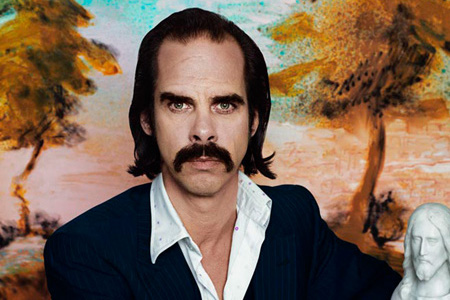
To discuss Nick Cave is to pose the question, “Can an artist be considered a canonical legend before he dies?” Like Bob Dylan, he is an artist who exists out of time, as if he has always been present in our and always will be. But while a major part of allure is Dylan’s enigmatic essence, Cave is far more direct, far less prone to toying with us—and, as he makes clear on Wild God [PIAS], nearly as artistically untouchable as His Bobness (who happens to be one of Cave’s heroes). Nary a single human being on planet Earth could cogently rebut the assertion that Cave is, unquestionably, a dyed-in-the-world artist with precisely no (living) peers—and, yes, we are including PJ Harvey, Warren Ellis, Mick Harvey among them. (The sole exception is Johnny Cash with whom Cave collaborated in 2003, the same year in which the national treasure passed.)
It would require writing a book to justly analyze, comprehend, and fully appreciate Wild God, quite possibly Cave’s best album of all time, on the whole. That is particularly appropriate because Cave—in addition to standing tall as one of the greatest musicians of the past 50 years, regardless of genre—is also a reputed author, composer, and actor. And that’s not even the half of it (or the quarter, fifth or sixth of it). A downright cruel battery of tragedies have befallen Cave over the years, with the deaths of two of his sons standing as perhaps the most devastating but by no means the only examples. It is beyond human comprehension how Cave has not given up on life; even more astonishing is his preternatural ability to become an even stronger, more confident and more spiritually devoted artist. Through his actions and even mere existence in this world support the argument that inner strength, not just pieces of work, should be considered in discussions about an artist’s merit.
In quintessentially true and transparent Cave form, he sings the following on the Wild God song “Cinnamon Horses”: “I told my friends some things were good/ That love would endure if it could … I said we can’t love someone/ Without hurting someone … Because love asks for nothing/ But love costs everything … I said we should not hurt one another/ Still we hurt one another … I told my friends that life was sweet … I told my friends that life was good/ That love would endure if it could.” Lyrics such as those are as precious as gold was when excavators rushed to the West to pan rivers for nuggets or even specks of it. And such delicately, consciously created, and literate lyrics are diminishing in culture due to the insurrection—no, not the political one at the Capitol four years ago, but rather the assault waged on our cultural lexicon and thrown into hyper-speed due to social media. We don’t know what words mean anymore. Which, in turn. means we cannot coherently communicate with one other. Which, in turn, leads to isolationism, social division, and other types of fracturing that we still have yet to comprehend.
For centuries—maybe millennia—we have assumed that profundity can only be expressed through language that is impenetrable to the layman. But as Cave told me in a 2003 interview around the release of Nocturama, “I just wanted to write songs that were lyrically simpler. … On the last record (2001’s No More Shall We Part), I felt a great need to pile on the words. I shied away from that on this record.” Cave’s decision to use that same tack on Wild God is absolutely critical and makes it one of this year’s masterpieces. As a man with thoroughly inventoried spiritual fortitude, commanding artistry, philosophical prowess and—most importantly—the knowledge of how to deal with grief, we absolutely needed Cave to hand us a musical decree convincing mankind that we can overcome shock and awe campaigns disrupting the lives of people across the world. Best of all, he achieves this magnum opus with joy and humor, ensuring the record isn’t a life-draining listen from start to finish. The Seeds and additional guests sing with an exuberance that very closely resembles the gospel-choir uplift that Jason Spaceman embedded into Spiritualized’s later work. Hard as it may be to believe, Wild God even has a laugh-out-loud lyric that reinforces Cave’s command of his creation. On “Frogs,” Cave sings—without deviating from his normal vocal delivery—“Kris Kristofferson walks by kicking a can/ In a shirt he hasn’t washed for years.”
With that lyric and a few other inside jokes, Cave doesn’t handicap or undercut his album with a lack of seriousness. They’re just occasional reminders that he doesn’t want to be anyone’s steely-eyed strongman, pastor, or cult leader (even though he would’ve made a great one). Surely, the worldly Cave is well informed about the widespread, demented, and self-injurious yearning for strongmen across the world, and the accompanying rise of authoritarian regimes in a growing number of countries. All of which to say that Cave, intellectual and artistic genius that he is, does not have the answers to all the world’s problems. But he is one of the most fluent and revered musicians on the subject of grief. With that in mind, when you are overcome with grief amid the tumult we need not detail, don’t search for an instructional YouTube video on how to cope with it. Wild God is a far more worthy star to follow in these dark times.












 The Bad Penny (beta)