From the Vault: Are the Pixies Milking It With Their Multitudinous Video Releases?
(Note: This essay was written before the Pixies released a fifth video, Live at the Town and Country Club 1988, in 2011.)
So, shocker: Some people have been suggesting in the five-plus years since Pixies re-formed that maybe the foursome – who are revving up for another trek – have only been doing it for the money. What a strange, bizarre accusation. Like the plot of a Behind the Music episode, it’s the most predictable question of all for any band getting back together: It’s been alleged of everyone from CSNY to Simon & Garfunkel to Eagles to the Stooges to My Bloody Valentine to Rage Against the Machine to Dinosaur Jr. to the Jesus Lizard and on. And on. And on.
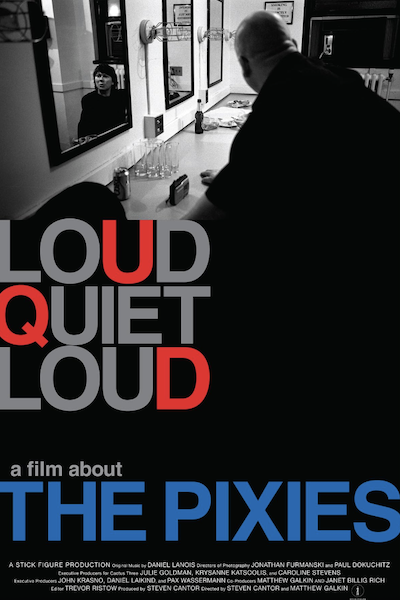
On the other hand, there is some potentially sound evidence that raking in the clams has been the main, if not only, reason Pixies reunited. As evident in the somewhat-illuminating doc loudQUIETloud, one of the DVDs we’ll be focusing on below, David Lovering was on the verge of going broke, falling back on his career as a magician – turning tricks in order to make ends meet, if you will.
Likewise, another telling moment in the film is seeing arguably the most emotionally guarded of all the Pixies, Joey Santiago, get the call that the reunion was a go. He reacted as if Ed McMahon (RIP) had just shown up at his doorstep. It’s more than safe to say that the guitarist, who struggled throughout loudQUIETloud with trying to complete a freelance film-score project, wasn’t about to retire to any islas de encanta anytime soon.
As the movie also portrays, Kim Deal needed a big endeavor in her life to fill the gaping hole left from the substance-abuse habits she was trying to hang up. Which just left Frank Black/Black Francis/Crank Cisblack/Hunter S. Blackson, whose motives still aren’t exactly clear, despite the other insights the movie does provide.
And another thing: For good reason, much ado is being made about the $495 price tag accompanying the limited-edition versions of the band’s kinda-not-so-eagerly-awaited box set, Minotaur. We live in an era when even baseball teams are being pressured to scale back and charge fans reasonable prices, so it’s worthy of a head-scratch to wonder why an indie-rock band is veering in the other direction. Then again, it’s fair to say that we live in an era when artists aren’t making much money anymore.
Streeting for the mere pittance of $175 is the regular edition, which, somehow, has been designated with the adjective “deluxe.” Calling the most basic version of a release “deluxe” is like using the term “bonus” to refer to any songs that appear on every version of an album.
All right, so maybe we’re nitpicking. But on a third and final note, a case could be made against the band – which, mind you, has only recorded two new studio songs in the past five-going-on-six years – for releasing no less than five DVDs since it reassembled. And that doesn’t even include the bonus video disc that was bundled with 2004’s Wave of Mutilation: Best of Pixies (featured content: a concert, promo videos, a pair of docs).
Now, coming at the tail end of those releases – which of course doesn’t rule out the likely issuing of more of them in the future – the flinty foursome have announced that they will once again be suffering themselves another reunion tour, this time so they can re-present Doolittle in all its anti-pop-germinating glory. And again with no fresh material to show for it. But, like our DVD roundup shows, just because they aren’t creating anything new – not yet, at least; a new album has again been promised, this time for next year – that doesn’t mean the Mt. Rushmore of Northeastern alterna-rock haven’t found a novel spin on their oeuvre.
To decide for ourselves if they’ve been milking it, we took a look at five of the DVD releases (minus 2004’s Pixies, which mostly revolved around the band’s previously released video catalog but also coughed up yet another documentary and yet more 2004 tour footage). And we found that, for the most part, the discs – all of which were released in 2006, notably – were all worthy of individual release.

loudQUIETloud: A Film About the Pixies
This movie is no Some Kind of Monster. Which is unfortunate, because providing a true inner glimpse of the Pixies members is still sorely needed.
After seeing both, it’s hard to tell who are/were the bigger head cases, the Pixies or Metallica. Whether psychodrama is a necessary evil of any great band – does their genius come from intra-band tension, like great novels supposedly come from tortured authors? – is beyond the point. What matters is that Monster exposed the aging, shorn metal sluggers as the greedy-but-still-redeemable bubs they are, while loudQUIETloud doesn’t pull the curtain all the way down on any Pixies.
The movie is properly positioned primarily around Frank Black, painting the scene at the beginning by focusing on the anguished-looking frontman braving his way through a phone interview with the UK press. He ends the interview apparently by speaking his mind as clearly as he can – trying to address rumors about the band’s notorious demise in early 1993 and the obvious lingering tension that sidled their re-formation. But, like the movie itself, the interview ends with the deeper questions being left unanswered: Who is Charles Michael Kittridge Thompson IV, and what is his true identity? Does he actually like – or even love – any of his bandmates?
We don’t get much closer to Kim Deal, whose omnipresent twin sister Kelley acts as a chaperone of sorts throughout the tour – lest Kim slip with her recovery. There is an endearing moment when Kim reads a novel written by a teen reflecting the massive impact the Pixies had on her life, but there are no words to accompany the moving sequence. We are left to wonder if Kim exhausted her soul-baring while in counseling, or if she is simply this closed.
Least of all, we barely get to know the real Joey Santiago. We come to know him as a family man who misses being with his wife and kids – as we see, while on the road, he often chats with them via video. But we hardly ever hear from him, and when we do, he comes across as a boxer gritting his way through a match, eager to collect his purse. He seems humorless, like someone deliberately detaching himself emotionally so he won’t be hurt again by his bandmates.
Which leaves Lovering, who inevitably had to take on a larger role in the film. Already in dire straits financially, he loses his dad mid-tour and falls into drug-addled depression before too long. He begins to crack, culminating in an onstage goof/freak-out that draws the wrath of Black. While Hetfield battled his substance abuse off-camera, loudQUIETloud presents a candid mini-chronicle of Lovering’s chemical-induced tumble – and rapid rebound. Even when he’s lying to his bandmates, he seems in many ways to be the most honest Pixie.
Where the film succeeds is in representing through its form its titular conceit: that what wasn’t being said (the quiet) was more important than what was being said (the loud). As we see, just about every aspect of Pixies has had this loud/quiet dichotomy – not just the way in which they structure their songs, and how Black alternates singing and screaming (he comes across like an infant who has a hissy fit at one moment and quickly goes silent upon being distracted or consoled).
The day-to-day life of the band on the road has a similar bent: They make a lot of noise (rehearsing, performing) for a good portion of their day, and spend the rest in virtual silence, either mentally hibernating or, more likely, stewing in their thoughts.
So, fittingly, the documentary includes long, quiet stretches that show the brooding, contemplative side of the Pixies, balancing out their explosive concert performances. But, unfortunately, the documentary falls short of giving us a better idea of what’s actually on their minds.

Pixies Sell Out: 2004 Reunion Tour
Did it really take this long for someone to make the connection between the positive and negative ways to interpret of the term “sell out”? Kudos if so.
At the heart of this set is a 28-song concert at France’s Eurockéennes Festival – refreshing, as most of the footage on the other DVDs is of their US shows, and the Europeans really deserve credit for latching onto the band before its own fellow citizens did. It’s fleshed out by 15 extra clips from other festival appearances and gigs from across the globe: Coachella, T in the Park, Austin City Limits, Fuji Rock Festival, Voodoo Festival, etc.
Gems on this one include “Levitate Me,” which doesn’t appear on any of the other DVDs; a pitch-perfect version of “The Holiday Song”; an epic rendition of “Where Is My Mind?”; Santiago playing his guitar with one of Lovering’s drum sticks on “Vamos”; particularly fierce versions of “Caribou” and “Gouge Away”; and the speedy triumvirate of “Crackity Jones”/”Broken Face”/”Isla de Encanta.” “Into the White” is another solid performance, while “No. 13 Baby” is cringingly out of tune.
It’s still bewildering to see such large crowds worshipping Pixies. Prior to the reunion, they had played to big masses like these – but that was because they were at those stadiums serving as the opening act for the likes of U2.
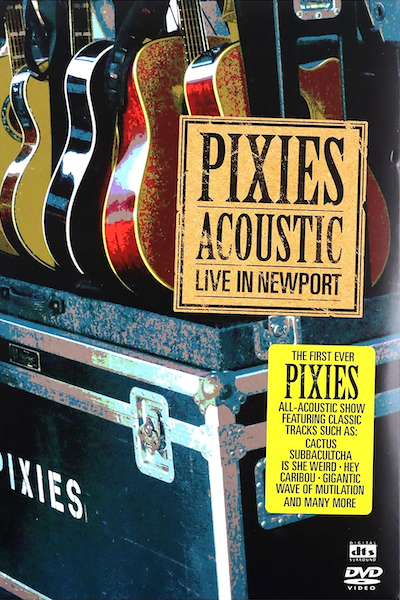
Pixies Acoustic: Live in Newport
This one might be the biggest must-have of them all, as it captures the group thoroughly re-examining and reimagining choice cuts. The selections are mostly obvious; the same way we tend to forget that Led Zeppelin III had substantial acoustic passages, so did Pixies material, especially the early stuff.
The Newport setting is an unconventional one – it’s a preppy scene, with yachts, beach balls, tie-dye peace flags, American flags and vacationing East Coast elites providing the backdrop. But the band is looser than ever, providing us a revealing perspective on the band. Santiago finally speaks onstage, sparking Black to remark: “Joe, since when did you get a microphone? I haven’t heard you say anything for, like, the past 20 years.”
They are off-the-cuff for much of the show, blatantly botching some newly learned tricks. But in the same way off-tuned songs somehow feel right to the attuned ear, Pixies’ mistakes don’t cost them many points.
What’s especially remarkable is that some of their music still succeeds in stripped-down form – which is to say, without the loud/quiet dichotomy that seems so crucial to their sound. Black even sacrifices his screams for the first half of the show, till he loses the battle during “River Euphrates,” but some of the songs don’t suffer.
Some of the songs, however, do really lose their oomph without the loud/quiet contrast, especially “Hey,” “Vamos,” “Where Is My Mind?” and “I Bleed” (one of their weaker early-career songs anyway). But others are invigorated with new life: Deal’s vocals are get some much-deserved attention in the spotlight on “Velouria”; “Mr. Grieves,” “Nimrod’s Son” and “Ed Is Dead” were pretty much folk songs in the first place; “Crackity Jones” is imbued with a distinct South of the Border flavor. “Cactus” and “Been Around the World” – their rare Neil Young cover – also deserve some special attention.
Not to be overlooked are the bonus features, particularly a rehearsal version of “Debaser”: They didn’t break out the song at the show, but it would’ve bested some of the other performances.

Pixies: Live at the Paradise in Boston:
The weakest release of the bunch, this one is for collectors/completists only. The reunion tour footage isn’t particularly awesome – not unless you take into account rarities like “Winterlong,” “La La Love You,” “Allison” and “Sad Punk,” which they dredged up for the small crowd of devout fans. Filling out the disc are 12 even harder-to-find – as in, previously unreleased – clips of one of the first Pixies shows in Boston, in October 1986 at TT the Bear’s. If you haven’t seen Kim Deal wearing mascara and earrings, you’re in for a treat.
(Speaking of appearances, the follicle-impaired hombres sure are lucky to have Kim Deal. Without her, Pixies might be accidentally mistaken for a band of neo-Nazis.)
The package itself seems hastily thrown together. There’s no indication as to which date in 2004 the band played at Paradise. Live at the Paradise is something of an erroneous title, since the TT the Bear’s material – incredibly rough as it is – is even more important from a historical perspective. The back of the box blares, “Club date is the gig you always dreamt you’d be at,” which doesn’t make any sense – it’s a conditional statement referring to an event that has already happened (“the gig you wish you had been at” would be more grammatically correct). And the artwork leaves something to be desired.
But hey, three of four ain’t bad.
UPDATE: We just got our mitts on a few promo videos hyping “Minotaur.” Scope ’em out, decide for yourself if the box is worth the bucks.
[This article was originally published on IndiePit in September 2009.]
 The Bad Penny (beta)
Leave a comment