The Visionaries: Lux Says ‘Joy’ Propelled Him to Make Post-Black Metal Split Release With Kindred Spirit Sadness
The greatest embarrassment a music journalist can experience isn’t accidentally misquoting what an artist said in an interview. It’s not asking a thoroughly banal question during an interview and not realizing how dumb it was until after the conversation concluded. It isn’t even rocking out at a concert, hard, for everyone to see, because the line between critic and fan can be so paper thin.
No, the real, deep-seated — even primal — despondency that courses through a music journalist’s body, shakes them to the core and compels them to reevaluate whether their opinion actually has any value whatsoever comes when the purportedly professional scribe “discovers” an exceptional musical talent, only to realize that thousands, or tens of thousands, or even hundreds of thousands of people caught onto the musician or band long before the supposedly intrepid journalist stumbled across them.
No one seemed to notice, but yours truly felt utterly ashamed in December after stumbling across blackgaze phenom Sadness and thinking the artist’s career was nascent. Turns out Damián Antón Ojeda (a.k.a. Elisa) launched the one-person project all the way back in 2013 and has released piles upon piles of records between then and now. Sadness also has a rabid fanbase, as evidenced by the 3,400 people who viewed our conversation on YouTube.
After sulking in self-pity for a spell, a new way of coping with the Sadness oversight arose. As Ojeda/Elisa frequently collaborates with other musicians who must be talented in their own right if Sadness chose to join forces with them, it made sense to start exploring some of those comrades. The experiment proved to be a success right away; after spinning a split EP called Dusk Garden that came out in October, we became introduced to the other participant, a musician from the Scottish Borders, south of Edinburgh, who goes by the name Lux and, like Sadness, has an affinity for post-black metal.
Lux hasn’t issued as many records as the hella proficient Sadness, but that’s in part because the artist’s first demo dropped in February 2019, at which point Ojeda/Elisa’s career was already six years deep. Regardless, after evaluating all Lux’s releases like a school proctor would do, we determined that we had found another diamond in the rough. And then, following our instincts, we reached out to Lux to find out not only what makes the artist tick but how Lux has developed such enormous talent without much help from anyone else.
We broke the ice with the post-black metal wizard with the following Q&A exchange:
Can you recall the first moment you fell in love with, or at least really found a connection with, music? What were the circumstances and what was it like?
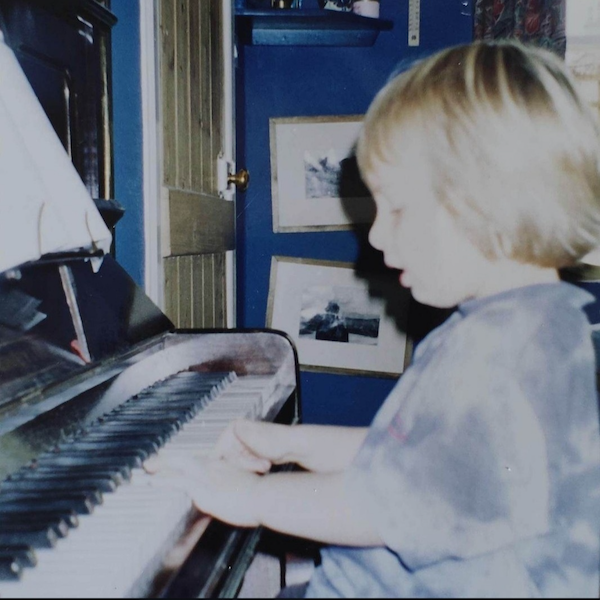
I grew up surrounded by alternative music, mostly my dad’s influence. There is an old photo my mum took of me at about 3 years old, sitting up on a piano bench and messing about with the keys on a piano. I have no memory of this, however, among my earliest memories is hearing heavy music in the house or in the car sitting next to my dad, and getting so hyped up and ecstatic from it.
What was your initial approach to making music — in terms of equipment, attitude and style — at the very beginning? How did it evolve to where you’re at now?
As I think back, certain bits of music are like portals to that experience and time, which is like magic. Two bands which are crystal clear in these very earliest memories are Brain Donor, Røger (This Is the Shit) and the album Drama Pit & Loan by Terminal Lovers from Cleveland. That came out in 2003, so I would’ve been listening to it at ages 3 to 4.
I was fortunate to be gifted with a tiny electric guitar in 2004 or 2005. I was obsessed with making chaotic noise from it, until a year or two later, I started fretting the strings and creating riffs with a full-size Epiphone Flying V. I remember learning how to play the riffs from Reverend Bizarre’s II: Crush the Insects [in particular] being a strong memory. After getting access to an acoustic guitar at about 9 years old, I started recording original songs into a computer and got addicted to that feeling of creative release and the joy it gave me. I did a whole short album with songs about animals called Animalize, which sounds like I just absorbed all the different alternative styles I was hearing growing up.
After several years, I was fortunate to gradually get access to all the equipment necessary to record everything myself. I think my commitment and desire to make full-length projects has never changed. When I initially started to release music, it was raw black metal under a project called Oblivion, and I maybe subconsciously kept it strictly in one style/genre.
As I have progressed with Lux, I have increasingly been not bothered about what category the music falls into and have just made music I love hearing and is my truest expression, whatever it may turn into. In many ways, this aspect of artistry I think I had in abundance back when I was 10 years old, making songs without any care for a specific style or audience, just doing it for the original joy I get from making things and what I love music so much for.
What came easiest to you making music when you started?
The easiest thing is how doing something you love tends not to feel like an effort or chore in any way. Sure, as I expanded out into different instruments, and more sophisticated ways of recording, things got more challenging, operationally speaking. However, the creative flow and reward I feel has always been there, which feels effortless. When I look back at projects I’ve made, my favourites are the early ones that weren’t restricted by higher production techniques and are really raw, messy and imperfect. However, I hear the undying passion I felt for something through all that which brought it into existence.
What’s the biggest challenge you’ve faced in your career thus far?
Sometimes the biggest challenge has been having other life commitments and not having full access to my equipment for months on end. I am always trying to learn not to be reliant on one space or setup for too long, and adapting so I will be able to consistently make music wherever I am. However, certain logistics can make this difficult. That’s the biggest reason why I’ve not enjoyed spending overly long amounts of time on any one release; I associate time constraints with artistic urgency and a sense of vitality. Also, as we discussed, being very isolated from other musicians has been the only obstacle for playing Lux live hitherto now.
Are you making music full time? If you feel comfortable saying what else you do, if you indeed do other things, please share.
When I have my recording space and working on a project, it’s 100 percent full-time, often to the expense of my sleep, haha. I get a massive buzz from doing it. However, I have also been engaged with studies at music school and trying different jobs over the years, which mean I take extended breaks from actually recording. (I still play/write during these periods, though.) At the moment, I’m about to relocate again and follow another path, so I will be adapting once more. Whatever I end up doing, I still find consistent windows of time for my music, despite it sometimes feeling on-off for me personally.
Aside from other black metal/blackgaze styles, over the years, I’ve taken a lot of inspiration from the works of Chet W. Scott (Blood of the Black Owl, Ruhr Hunter); electronic music like Burial, Aphex Twin and Susumu Yokota; and Ben Chasny (Six Organs [of Admittance], Comets on Fire). Also, of course, various emo, post-hardcore and screamo stuff, which I love bleeding into my original metal roots.
Stay tuned for more of our conversation with gifted musician Lux. In the meantime, learn more about the artist and listen to more of his songs on Lux’s Bandcamp page and his Instagram account.


Leave a Reply