On Tyranny: An Epic Conversation With Anarchist Art Collective and Cursive Collaborators INDECLINE About Fascism And How You Can Fight It
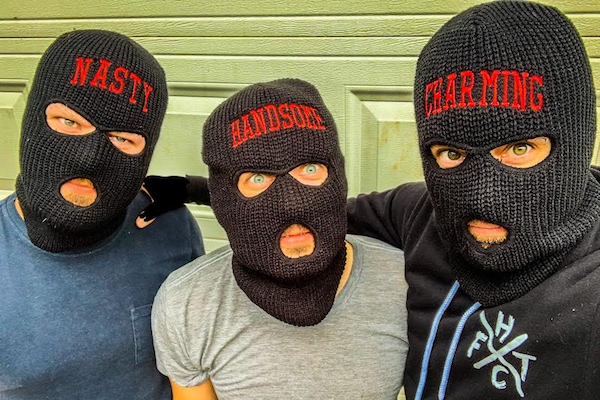
The Bad Penny is embarrassed to admit that we only discovered INDECLINE, an American Anarchist art collective whose work has had tremendous impact on the underground and even the mainstream, for more than 20 years. We caught wind of the group, whose members wish to remain anonymous, after they collaborated with Cursive for their video “The Avalanche of Our Demise,” which the Tim Kasher-led indie-rock band released last month. Upon further investigation into INDECLINE, it became obvious that they would be a boon to On Tyranny, for they would certainly introduce new ideas and perspectives in the series we launched roughly a year ago.
And boy did they ever. Formed in 2001, the decentralized group of musicians, graffiti artists and others have fearlessly devoted themselves to bringing attention to the evils of capitalism, the death of democracy in America – and, on a more positive note, how we can build a better society. INDECLINE’s most prominent works of public art include statues of Donald Trump in the buff, glued to sidewalks; and their “Ku Klux Klowns” installation that served as a response to the Unite the Right rally in Charlottesville, Virginia, in 2017.
We could expound a great deal further on INDECLINE’s history and accomplishments, but much of that information is covered in the longest, boldest and most informative installment in our On Tyranny series. So, without further ado, here is the epic conversation
As this is a website that primarily revolves around music, let’s start something in that arena. Is Cursive the only band that you’ve teamed with so far?
No, we’ve done a lot of music videos, primarily across the punk world. We also did that Art of the Protest documentary, which featured interviews with a lot of activists, as well as musicians who tend towards the political.
Nadya [Tolokonnikova] from Pussy Riot was in it, Tom Morello, Emory Douglas, a whole bunch of others. I think we relate well to artists of all different mediums, because a lot of what we do has to do with engagement itself, both with the traditional media — as in the news that covers our projects gives them context — but also the social media through which we’re able to present these projects to people, since most people don’t see it in situ.
Like when, we did the prison cell art gallery in Trump Tower, the only people who were invited were some representatives from the media, because obviously you don’t want to be caught in the middle of hosting an unsanctioned art show inside the president’s hotel.
And was that something that you organized personally, or did your group coordinate that?
Yeah, yeah, our group. I mean, everything is our group. It’s a policy. We’re a collective, so we tend to look at what we do as divorced from individual personalities. In the past we’ve seen how, in these spaces, personality—or really it’s the cults that form around it — that can make it hard for people to stay focused on the message. As a species, we have a habit that goes back all the way to, like, the John Barleycorn ceremonies of making celebrities these supernatural representatives, putting them on a pedestal, and then punishing them for it later.
We’re very much trying to stay out of the baggage that comes with personality so we can just talk about the message. It’s an underlying philosophy, especially being anarchists—like how most of the important achievements in human history come out of collective activity, where people are free to engage with each other in a spirit of play and collaboration, not hegemony and coercion.
So, we’re trying to model that the best we can in how we do our projects, which are primarily artistic and therefore easier to model these kinds of organizational structures, which is how we can refine them and make them more accessible for others who feel inspired by what we are doing.
Artists tend to be collaborative people, and we work across such a wide variety of mediums.
—
“One of the graces of aging or maturity is that you begin to spend the majority of your energy thinking about those more constructive parts of the process than you do the destructive ones.”
-INDECLINE
—
Yeah. So, you know, getting into brass tacks, like, what form do those collaborations take?
Are they, you know, you mentioned art installations, but are there other, like, sort of partnerships that you can make where they’re a little more anonymous or, you know, creative, nontraditional? You know, what do I guess what I’m trying to drive at is, like, what kind of programming do you sort of implement?
Well, I mean, we’ve got, like, 20 years of different stuff, some more experimental than others. Some more successful than others.
We’ve done an awful lot of billboards. We’ve taken up the mantle from some of our heroes growing up, like John Law and the Billboard Liberation Front, as well as Ron English. We’ve done installations, pranks or stunts, performance art, even proper art shows, but we’ve also worked with outreach groups directly, like the Sidewalk Project in Los Angeles.
Or, for example, we once did a project in with SUGABOMBING, PEMEX and NEKO where, instead of altering the billboards, we just cut them down, selectively choose ones that were statements upon the situation with gentrification and homelessness in the Bay Area, and then fabricated them into huts using easy-to-duplicate PVC frames, which were then distributed at the encampments in Oakland. We have done music videos, like the Cursive one, where the message they are featuring kind of matches up with the type of work that we already do.
Certainly, people don’t come to us for your average, run of the mill music video. We have a pretty specific voice that centers around our politics, which is basically just our activism. Very hands on. We also shot a play during the pandemic, a political allegory about how politicians change in order to accrue the increasingly destabilizing amount of power it takes to ascend to the top of our political system.
Then there’s the huge open air art installations like Death Metals, in Gold Dome. We did the largest ever piece of illegal graffiti on an abandoned runway they used to test bombs during WWII in Cuddeback Lake, near Death Valley.
All of this centers around the messaging, though, to counteract the steady stream of propaganda and advertising that most of us are submerged in all day long, every damn day.
—
“The entire process of advertising is kind of silly. I don’t think people [are] deeply offended when they see our work … it’s not like we’re defacing the Vietnam Memorial. We’re actually defacing junk. It’s slop. We applied to AI these days, but that’s what advertising has always been: slop.”
-INDECLINE
—
Has that resulted in you having, you know, to go to jail quite a few times?
Not necessarily. I mean, there are close calls, tricky situations arise, but a lot of care goes into planning these things. Our large part of our background really comes out of graffiti culture, and the idea there is not to get caught.
Sure.
There have certainly been instances over the years, but we try to be safe and organized, to do things to maximize our effectiveness while lowering risk as much as we’re able to.
Right. So, kind of stepping back a little bit, when did you join the organization and what drove you to do so? Was there a moment in your life that you had sort of a moment of clarity where you’re like, there’s just injustice everywhere and I need to do something about it? Did you reach a certain age where you felt like a sense of purpose, or was it maybe like being exposed to different political or philosophical beliefs or, you know, what was it that propelled you to get into this area?
I think there was a lot of Howard Zinn and Noam Chomsky in our respective youth, a lot of punk-rock lyrics, all mixed up with skateboarding subculture, graffiti subculture, and just the attitude of music and art as a very exciting form of resistance, in general. Really, all of these things tend to be anti-authoritarian, to some degree.
When you’re very young, it can be more difficult to separate from the general resistance — or like… destructive attitudes are a part of those cultures, kind of counterintuitively, through the creative force that underlies them. What makes you want to build new things also makes you want to tear the old things down. As a man, in particular — we are known for having less risk-assessment function, especially in our youth.
So, what I’m saying here is, you start out wanting to break shit, and you spend a long time just wanting to break shit, because that’s the original impulse in resistance. And then, one day, you wake up and say, “Well, if we break everything, what are we going to put in its place?” And I think, often, one of the graces of aging or maturity is that you begin to spend the majority of your energy thinking about those more constructive parts of the process than you do the destructive ones. I think that’s held true for us.
But it’s been a gradual thing. I mean, there’s projects we’ve done over the years that we probably wouldn’t do today. You know, the messaging gets better with practice. And I think we have gotten a little bit more thoughtful about what we do, because there’s feedback through interacting with other people, both our peers and our audience.
Can you point to one circumstance in which you found that your approach had evolved into something that was more effective than it was when you initially tried to execute it?
The billboards. We’ve got a book, Control, Alter, Delete that we’ve done, and a companion video, and you could probably pick, looking at them, which ones are newer, or older. Like I said, art’s a growing experience, a feedback loop.
Speaking of billboards, I would love to mention Marshall McLuhan, some of his thoughts about media and, in particular, the mediums that we use as well as how they affect us. For all the different methodology, our primary medium … it’s almost anachronistic, but it’s still the old-school news media. That’s the canvas that our particular kind of protest art is sitting on. Like, we need people to report on it, even if afterwards, we’re still pushing it out through social media, because half of the schtick is the reaction.
When you see a newscaster reading — and this is going deep into the archives — a billboard about sausage McMuffin with E. coli or something ridiculous, there’s another layer in the critique that is effective just by people realizing how silly it is. Both the alteration, but then, perhaps, the original message.
It’s live on air, but you have someone chuckling. It’s funny, sure. Because, you know what? The entire process of advertising is kind of silly. I don’t think people [are] deeply offended when they see our work, because it’s not like we’re defacing the Vietnam Memorial. We’re actually defacing junk. It’s slop. We applied to AI these days, but that’s what advertising has always been: slop. And it’s only getting sloppier. And in doing so, it’s attempting to get you to consume something you don’t need to consume, because capitalism, that is just the hyper-fanatical fixation on consumption as its own purpose.
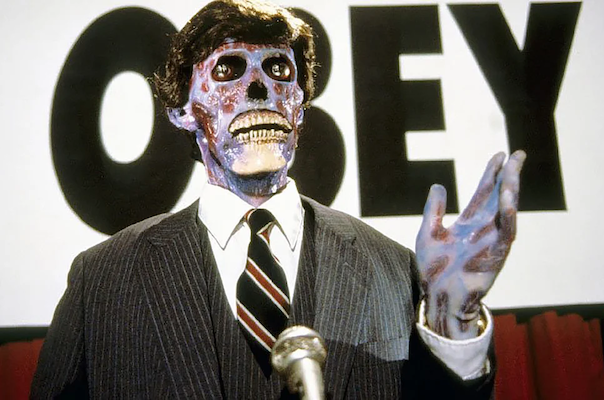
I’m hearing a lot of allusions to John Carpenter‘s They Live as you’re talking about these things.
For sure, there is a connection there through Obey and Shepard Fairey. That is certainly the messaging we grew up on. Very much in the vein of 1984, as well. You can even go back to Jacques Ellul writing about propaganda, but also, even folks like [Edward] Bernays, the very people that were making it and discovering it organically, the kinds of people that populate shows like Mad Men. At its core, it’s the ability to convince people to see the world differently than the way that their senses are telling them it is.
Advertising is almost like a dissociative drug, because this is the primary thing that capitalism does — it dissociates us from a sense of self, which also, wrenches us out of a larger sense of community, by trying to convince us that everything is fungible — which just means able to be exchanged, able to be reduced down to a number with no context, other than a quantitative measure of value. And therefore, that number is always interchangeable.
Two is always the same two, it’s not two apples versus two oranges, it’s just the idea of two. The idea, divorced from the unique lives that measure meaning. And that is what capitalism is always trying to do with our interactions. Especially in the world today, where capitalism has also become the mediator of our self-esteem, through social media, so that now, instead of trading in dollars, we’re trading in likes, tweets, whatever it is. Some tunnel of feedback and noise that seeks to aggregate us away from the most common-sense experience of our humanity, which is that each of us lives a unique and individual life. Not a fraction of an aggregate. We are actually complete beings. But being divided into various demographics and target audiences, it wounds us, every day, our self-image, so that we make better consumers. Empty, hungry, incomplete, always one product short of being worth the space we take up.
And to some extent, maybe we’re not so special, because there’s eight billion plus unique and individual lives. But from the place that we’re standing within our relative experiences, there is no one who is living exactly the same experience that I am — anywhere. So there is a sweet spot between agency and compassion that takes collaboration, dialogue, refinement, and the point of capitalism is to distract us away from that hard work, so that we will keep paying rent forever on their nonsense saccharine dream, instead of living the life in front of us, with all the lovely people that surround us.
Yeah. And as Timothy Snyder says in On Tyranny, the inspiration for this series, don’t let an authoritarian government change who you are, your beliefs and values and morals. Because then they will have won. Another refrain of his is that the strongest tool of an authoritarian government is to convince the public that they can’t relate to their neighbors, which in turn create social isolation that handicaps efforts to mobilize resistance efforts.
Mass movements of all kinds usually begin with alienation. It’s one of the concepts that Hannah Arendt grappled with the most in The Origins of Totalitarianism. Eric Hoffer is another contemporary who struggled with that internal conflict, like, how do you get a person to work against their own self-interests? How do you get them to beg this destructive authoritarian figure to take their agency away? And since this series is about fascism, or whatever we want to call its modern, weird-ass sequel, these questions resonate today – all the same questions as then, really. So we can look backward for the answers. Like, how do you get people to invest in a system which can only support itself as long as it continues to consume its own members?
That always starts with “othering.” In the wake of colonialism, Hannah Arendt talked about how we projected these “others” from the wreckage of plunder and extraction to come up with our militarized nationalist identities. But ironically, fascism doesn’t usually have a super long lifespan as a political movement, because it can only exist as long as it’s continuing to feed on its own population.
Once you start with “Final Solutions,” that band narrows and narrows to feed the war machine, because fascism is the most hysterical form of consumption, as a political identity, versus, like, a regular despot. Fascism appeals to the True Believer, who again, is a bit of a hysteric.
—
“We can look backward for the answers. Like, how do you get people to invest in a system which can only support itself as long as it continues to consume its own members? “
-INDECLINE
—
But there is a reason why strong men manage to last for decades, like Pinochet or Putin (or even, you know, the one we’re field testing in the US right now). It’s because they’re no longer actually completing the promise that fascism originally makes: I will purify this country of all outside influences. But if you take that seriously, there are never enough outsiders. The band narrows until no one is left. Instead, successful despots that survive the initial consolidation of power create this kind of paranoid fugue state, where the actual violence of it becomes a form of kayfabe.
[French historian Paul-Michel] Foucault talked about how in earlier systems, like feudalism, punishment is as irregular as it is capricious. Maybe nine out of ten people get off scot-free, but when they do catch someone, they just execute them, no trial, right? The divine will of the king, of God’s chosen tyrant. These earlier constructions of discipline and punishment can be affected to keep these hyper-violent strongman States in stasis, where they’re not actively consuming their entire population but arbitrarily inflicting the most extreme consequences on any given citizen in order to keep their population in fear of any subversive activity.
It’s a promise they can’t actually keep at scale, which is always their weakness, and is kind of contrary to the more traditional Neoliberal, Panopticon surveillance-society, where everything you are doing is ostensibly seen, recorded, until eventually, it’s the cop inside your own head that’s doing all the heavy lifting. One of the most challenging things for people to deal with right now, in this country, is that we’re somewhere in the middle of both, vacillating with the freakish political tides. In fact, I don’t even know if Trump is a great example of what I think of as a normal fascist dictator.
He reminds me of the campaign version. The soap opera version. Serialized more than serious. The people around him, the bureaucrats, are maybe the fanatics, but he’s actually a performer, an entertainer. He’s like the Macho Man Randy Savage of dictators. It’s so ridiculous.
—
“Hyper-violent strongman States in stasis, where they’re not actively consuming their entire population but arbitrarily inflicting the most extreme consequences on any given citizen in order to keep their population in fear of any subversive activity.”
-INDECLINE
—
Funny you say that, because Trump actually is in the WWE Hall of Fame.
I know. He just does things you shouldn’t do if you want to effectively be a despot. For example, there are rules for propaganda, and Putin’s pretty good about this. You never directly flat-out lie in real propaganda, because a provable lie can interrupt the spell of crowd-think with dissonance. What you do is you just constantly devalue truth. You make the population cynical, to the point that it is no longer working against you any more than it is your opponents.
It’s a lot of whataboutism and hollow words and cliches that finally become entrancing, over time. We are like the lobster in the pot [of slowly boiling water] right now. I think that’s our struggle, digging in, not letting the distractions lull us with outrage and despair. Learning how to survive when they start to “flood the zone with shit,” so we don’t drown in it. And to me, it all comes back to how the internet has changed our interactions with each other.
That is why we’re echoing right now, as a society, reentering this period of history that it seems like we just recently solved. But the internet is such a powerful medium, an originally cool media that has gotten red-hot on us with all the algorithmic aggregation, the infinite feed that mainlines into your brain rot, and it’s a very subtle form of hypnotism. Not as dramatic as Hitler’s radio speeches, the way Trump rambles for hours on Fox News about nonsense until it doesn’t matter anyway.
Once upon a time, it was the collapse of colonialism, combined with the rise of industrialization, that was creating this huge global interaction between people while also stripping them of their humanity, from so many different angles. That’s how alienation first infected society last century, a sense of a future that had no more use for the people that had built the very factories that were now replacing them.
And I think the internet has begun to do that in a more cerebral manner. Not as the means of production but as the consumers of products and then, eventually, the producers of content — a mostly unpaid labor, for the record. It leads us down a slippery slope towards this more modern sense of alienation, where although we’re more globally connected than ever, we’re also more siloed within our own personal narrative, one that’s fed by acres of data centers into own personal algorithms that present whatever narrative we’re consuming into our own personal aggregation.
They make it sound universal, even though it’s so specific to each of us, the byproduct of all this data they harvest. Numbers, fungible numbers that can be programmed. A life reduced into code, fed through the program to become junk in order to sell us other junk. Everything we see now is curated exactly to us. And yet every single one of us mistakes it for, like, the voice of God. We all assume that’s also what everybody else sees in their feed.
For sure. Yeah. And how better to alienate somebody than to create AI and robots to sort of assist them with the mundane aspects of life and tasks and chores and ask them in a very rote way like, how was your day? I mean, this illusion that these AI and all that, that they care. It’s just so sad.
I want to go back to one point you made too, which is like, I think you said hegemony. I think also divide and conquer. Demagoguery. I’m in Idaho. What’s going on here is that when people get so financially crushed and have no future and no hope, and they can’t tell their kids with a straight face that there’s going to be a better life for them … when you demoralize and crush people like that, then it crushes their sense of hope, purpose, aspiration and even motivation.
There’s also a large contingent of people who feel completely hopeless and their attitude a lot of times is like, “Well, if I’m going to go down, I want to take other people down with me.” That’s a real scary thing. We have about 10 minutes left. Can you talk more about Foucault and the Panopticon concept he created?
Yeah. Well, Jeremy Bentham designed the first Panopticon Prison, but Foucault expanded greatly on the idea as a metaphor for the modern conception of power. … The underlying point of what you just said is that the problems are universal. One of the most profound books I’ve read in a while is this new Naomi Klein book, Doppelganger. It’s so interesting and relevant, the way she talks about diagonalism, doppelgängers and the mirror world. Like there’s a strange way that Marjorie Taylor Greene and AOC share a lot more in common than any of us should be comfortable with.
Because what makes them both so successful is a level of media savviness, you know? The idea is representation, branding, narrative control, constant mediation of every opinion, platform, perspective. This sensation that we are all spiraling into the sludginess of the slop. It’s like, we don’t even watch videos of things anymore. We watch videos of people reacting to videos of things. It’s not post-modern anymore. It’s hyper-modern, like, in the sense that hyper-pop is a genre now.
But that layering of how we consume things, again, ties in with this deepening sense of dislocation, again, that spiraling hole of alienation that people fall down. And the farther they go down that hole, the more alone they feel, while also assuming the rest of the world is sitting right there with them. Their opinion is the one opinion, the only opinion, the Logos. At the center of all conspiratorial thinking is this kind of gnostic, antagonistic relationship between the world and our supposed secret, sacred, even proprietary understanding of it.
Well, fascism is rooted in this idea of mass psychology. It’s the religiosity of the State, Manchurian to the max, and that’s why the State must make all your decisions for you. Freedom is corruption, vulnerability to the forces of evil, who have a supernatural advantage over us. Fascism offers an easy answer. We are good. Our enemies are evil. Don’t worry about what we do or say, God works in mysterious ways.
It’s no wonder people are susceptible to those kinds of narratives, those fascist narratives, in a world where our political systems are so complicated that, for example — to understand just American politics, I mean, let’s skip geopolitics for now — but just to be current in American politics, you got to know 200-and-something-odd names, what they do, why they’re important. I mean, it’s probably at least 50 names at a time on any given day to get through one revolution of the media cycle. The fascination with personality that we are, as a collective, so wary of, it’s because our national politics, our supposed venue to enact change and enforce justice, has been turned into a thing where it’s mostly entertainment based.
Neoliberalism is what causes fascism. For fifty years, both parties have been doing all the same things with different messaging — surveillance, attacking education, liberalizing financial markets across the world with great cost to the environment and severe consequences in places we often refer to as the Third World. Imagine that… Third Class Citizens of the New World Order. We say it like it doesn’t even mean something. Like it’s a pre-existing condition and not a consequence of our behavior.
But that’s how the State does it. Increasing the presence of violence in our lives, or at least in our psyches, even as it reduces the actual amounts of it. Assigning the idealized cop to our heads to do the work for them. I mean, we are as afraid of crime as we have been at any point in the history of our country, as crime rates have continued to decrease, you know? People don’t let their kids do anything alone. They are legitimately afraid of sensationalized news stories that are designed to make them that way, not to inform them.
—
“The fascination with personality that we are, as a collective, so wary of, it’s because our national politics, our supposed venue to enact change and enforce justice, has been turned into a thing where it’s mostly entertainment-based.”
-INDECLINE
—
Thirty percent lower in most American cities, if I’m not mistaken.
And the wars continue to get fought for ratings, for resources, for land. While in a system like capitalism, things are put under increasing pressure, which helps them manage the burden we are bearing for them, the burden of inequality. Because capitalism, again, it’s aggregation. Aggregation towards fungibility. Or to say it another way, crowd psychology often reduces us to our lowest common denominator. Rage or rapture, and the path to rage is so much shorter. And it’s less accurate at finding the root causes. Rage loves scapegoats.
But what’s craziest, to me, is that not even the tech bros, the ones living these kingly lives, seem very happy. Or its not super obvious in the way they behave.
They seem super self-conscious.
Exactly. Like preteens just learning to socialize. Supposed geniuses (self-titled), and yet they all have such a stunted emotional intelligence. So, the question is, what is capitalism actually accomplishing? But we’ve already covered that. All it’s really doing is math. It’s just aggregating.
It’s making everything fungible, fungible, fungible, until it’s as if the math itself has taken over. Right as we are building the very AI all these same dorks keep predicting will overrun us. How are they supposedly so helpless against the monster they haven’t even finished building? How are these our leaders? Because they aren’t leading.
They are part of the math too. Just with private islands instead of student debt and awful credit. The best way for us to fight this — and this is the reason that we’re anarchists — is just to, like, start and build community.
Wilhelm Reich, who I saw someone else mentioned in this series, had this idea about how the family unit becomes the molecular structure of fascism, as opposed to the wider community. It’s enforced with this kind of domineering patriarchal vision of life.
And you can see it right now, the Trad Wives and the Manosphere, all these archetypes coming back just in time to enforce these values for the State. The best way that we can fight back is get outside of our own comfort zones, talk to people, challenge ourselves and our own preconceived notions as well as those around us, especially the people we agree with.
We should be challenging them more than anybody, because they’re actually listening to us, respect our opinion, and we can begin to build more resilient structures at the ground level in our closest relationships. The fascists are… They are enforcing values.
So, are we offering more than a critique, on the left? Are we making praxis or just shouting about how the sky is falling? Is Identity Politics, as a corporate branding device without the real civil rights legislation, an attempt at correcting the injustice of the past or just another cynical attempt to find new markets? Ask the Supreme Court what they think. They’ve been real vocal lately.
Maybe, instead of trying to figure out how we can put people into the seat of power, we should spend more time reflecting on the tools we already have, on hand. Because the entire problem with the way the world has run for so much of human history is that power is re-concentrated as quickly as its reimagined, which is always beneficial for a small fraction of people, at the expense of the rest of us.
Anything you can do to atomize, to disseminate power, to restructure authority into autonomy in your own personal relationships and the relationships you build in your community — communality is number one for stopping this sweeping riptide that’s dragging us back into this consensual hypnotic state of violence and terror. That is the bedrock of fascism, both historically and today.
—
“I know people got to make a living, but we also need to remember that the message of capitalism, again, is fungibility. It’s dismantling your self-esteem down into an appetite for consumption. Not all “content” is the same. Some of it is art. Some of it is culture. And some of it is straight up crap. Some of it is hell-bent on making the rest of the world crap so it can continue to compete.”
-INDECLINE
—
Absolutely. Hey, have you seen that One Battle After Another yet?
Yeah. Loved it.
I love when Benicio Toro’s character says, “Ocean waves, ocean waves.” And maybe even more so, when he says — and I’m paraphrasing — “You know what freedom really is? No fear.”
Exactly, and all the state’s power comes from fear. All of it… from fear. It’s not even what actually happens to us. It’s what hasn’t happened to us yet, what might not even happen to us at all, except we are convinced by the “omniscience” of the state that not only is it possible, it must be inevitable then. In fact, our greatest fears work so well because they are as often as not unlikely to happen to us.
It’s the very absurdity of it happening that makes it impossible for us to cut through the dissonance. Why would I be more scared of a conspiracy theory than Global Warming — an actual, in-the-open collaboration between multinational corporations to drain the planet dry so they can buy another yacht?
Right. Yeah. Well that’s, that’s really like, um, not to turn this into a thing about myself, but like, um, it was back in March and, um, I was really at a crossroads where I was like, am I going to just not talk about what’s going on in my music writing? Because you know, um, there’s still a lot of musicians I run into who say, “Oh, I don’t do politics.” I have to explain to them it’s not about politics anymore. It’s far greater than that.
I felt a palpable sense of fear during the DOGE craze in particular. Wondering if Elon might just, on a whim, zap WordPress blogs. But like the moment I decided to start this series by talking with artists about the fascism an tyranny that’s taking place now, it’s had a snowball effect where more and more people seem to be wanting to do it, and they feel safe talking about it. I hope that everybody can realize that, no matter who you are, you can do some small part. That’s the only way out of this, really.
Right. But really, who cares the amount of followers people have? The stuff that has the most followers is increasingly bad, increasingly managed so as to be a non-challenging vehicle for advertisements. Empty calories… Junk food… And it’s moving to a point where it’s all going to be AI slop anyway, just cannibalizing itself. It’s a part of information theory, that dynamic systems don’t sustain themselves without consistent, new input. You can’t have a dissipative system without a larger environment to refresh the closed system that is churning out material. You’re subjected to entropy until all that’s left is noise and waste.
So these things that we do, or create, as artists — these are actually what’s moving culture. Even AI, at its most effective, is just regurgitating what has already been done, at a lower and lower fidelity. It has no bearing how popular things are or how much money they’re making. That’s not culture, that’s business.
I know people got to make a living, but we also need to remember that the message of capitalism, again, is fungibility. It’s dismantling your self-esteem down into an appetite for consumption. Not all “content” is the same. Some of it is art. Some of it is culture. And some of it is straight up crap. Some of it is hell-bent on making the rest of the world crap so it can continue to compete.
—
“It all comes back to how the internet has changed our interactions with each other. … The internet is such a powerful medium, an originally cool media that … mainlines into your brain rot. It’s a very subtle form of hypnotism.”
-INDECLINE
—
Another good book, for people interested in any of this is The Culture of Narcissism by Christopher Lasch. According to the book, or what I remember, narcissism arises when people’s self-esteem becomes so damaged that instead of having an internal bedrock, what they see as their self-image or their self-worth, they have to project everything going on in their head out onto the environment, until everybody else around become participants in the drama of their self, which has no real base. Because the self-esteem never solidifies, through resilience, through secure attachment; there is no border or boundary to it. It just becomes everything.
And again, that’s social media. We’re projecting. It’s a hologram of our sense of self, our brand, as they say, that we’re projecting in place of a personality, by employing all of our friends as followers. They are consuming this doppelgänger version, this online self, at the expense of our real, meaningful relationships. And we are consuming the attention, in return. Harvesting it to feed our wounded egos. It’s craziness.
In a tangential way, it also describes Trump. Everything he says is a projection of his own insecurities. It’s so easy to see what his weaknesses are because he accuses other people of having those weaknesses.
Absolutely. Thank you for your time and for all that you’re doing. I hope you understand it’s important. In times like these, we have to remember every piece of it is important. Just being human and doing human things is like the ground floor of resistance. Don’t let anybody tell you differently. You. Us. The audience. The cop in every one of our heads. We need to keep telling ourselves this so that we don’t get worn down. It’s great that you’re doing this.
Thanks, man. The pleasure is all mine.
Learn more about INDECLINE on their website.
Check out these videos in which INDECLINE collaborated with some of this website’s favorite artists:
Billy Strings – “Watch It Fall”
Codefendants – “This Is Crime Wave”
Codefendants – “Right Wrong Man”
William Elliot Whitmore – “Don’t Pray on Me”
Nick Shoulders – “Won’t Fence Us In”
Deaf Club – “Pain in the Assery”
Jack Evan Johnson – “I Am You”
For even more on the resistance against fascism, go to The Bad Penny‘s On Tyranny archive. And don’t miss these recent installments of the series:
• Musician Joe Turmes, No Kings Organizer, Says What You Can Do to Help Resist Fascism
• Thalia Zedek Suggests ‘Artists Should Boycott Playing the United States’
• Too Much Joy Discuss the Existential Ruin That MAGA Has Inflicted Upon Us
 The Bad Penny (beta)
Leave a comment