On Tyranny: Italian Psych Band Malota Reflect on Mussolini’s Legacy as US Faces Fascism
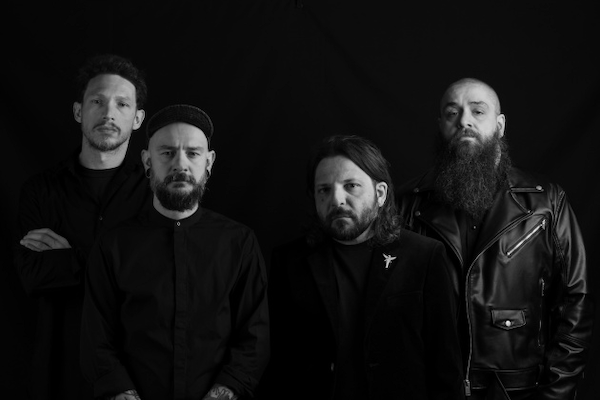
“Every day could be one’s last, whether because of repression sparked by even a single misplaced word of dissent, or because of the indiscriminate bombings.”
-Malota’s Max D’Ospina

With its canals and bistros and overall sense of tranquillity, Venice, Italy, is arguably one of the most picturesque, luxurious places on Earth – which makes it no wonder that it’s also one of the most popular tourist destinations anywhere. Dig a little deeper under the surface, and you’ll find that it also has to offer – perhaps conflictingly to some, but not necessarily musically erudite readers of The Bad Penny – a heavy psych-rock band very much worth its (Italian sea) salt.
Said group is Malota, a quartet whose new album, Scapegoat, dropped in mid-October via Go Down Records. While their mesmerizing record is worth not just perusing but purchasing, when we had the opportunity to interview the immensely talented troupe, we forewent conducting a typical banal back and forth about Scapegoat. Instead, we picked the brain of Max D’Ospina (bass, piano, didjeridoo, vocals) about fascism, a toxic political ideology that Italy defeated less than a century ago and that is currently corroding what little remains of democracy in America.
It used to be said that “history repeats itself.” Wisely, and fortunately, historians have amended that aphorism to say “history does not repeat itself exactly, but it rhymes.” Perhaps we can learn something from what D’Ospina had to share about the horrors that happened in his homeland, which he bravely shared with us.
“Thank you for allowing us to take part in such a different kind of interview — one where we can set ourselves aside for a moment and instead focus on what has led us to the reality we are living in today, and talk about what many people are even afraid to remember,” he said as our email exchange began.
No, Max, thank you for opening up about such a painful and personal subject – and thank you, dear reader, for having the wherewithal and concern to try to understand what is happening in Authoritarian America and how, hopefully, we can reverse course.
So, without further adieu (oops, wrong language), we present you The Bad Penny‘s interview with Malota:
Did your ancestors ever tell you what life was like under Mussolini? The more anecdotes you can share, the better.
My grandparents were reluctant for many years to speak about their lives during the Fascist regime. As time passed, they gradually opened up, and what emerged was a picture of a life that was anything but easy. There was no real sense of safety — every day could be one’s last, whether because of repression sparked by even a single misplaced word of dissent, or because of the indiscriminate bombings carried out by the Allied Forces on both civilian and military targets. Food was rationed, and there were socio-political obligations that left no room for personal ideology or ideals.
My maternal grandparents (who lived in northeastern Italy) were children at the time, so they experienced and took part in daily life and in the local resistance only to the extent that their age allowed. My paternal grandparents (from southern Italy), on the other hand, lived those years much more intensely. My paternal grandfather served his country, only to feel betrayed by it — eventually finding himself fighting against the very state he had once defended.
My grandfather was born in Italy, became a U.S. citizen at Ellis Island and then fought in Germany, earning a purple heart. Did your ancestors fight for the Axis or did any of them defect?
As mentioned earlier, my paternal grandfather served in the Royal Italian Army. He was sent to Russia during the ARMIR campaign [Armata Rombardia), the Italian Army’s expeditionary force in Russia during WWII], where Italian soldiers discovered the true face of Fascist Italy: They were abandoned, left to die without proper equipment or clothing, exposed both to Soviet attacks and to the brutal, deadly cold.
My grandfather managed to return on foot, traveling along roads literally paved with the bodies of his fellow soldiers and witnessing scenes of survival-driven cannibalism. When he finally made it back to Puglia after months of traveling, he became a partisan. He was captured by fascists and deported by ship to labor camps in Eritrea.
During the crossing, the ship carrying him as a prisoner was bombed by the Allies. He did not know how to swim, so he chose to remain on board; even then, he witnessed people being swallowed by the sea and by the currents created as the vessel went under. He was eventually rescued by a nearby British ship.
To what extent do you find that fascism influenced Italian art before, during and after Mussolini’s reign?
Despite the ignorance and ideological rigidity of the time, Fascist Italy produced remarkable forms of art — from painting to literature to architecture. The regime imposed no real artistic restrictions on painters: They were free to work in styles ranging from the new Futurism to classicism. Indeed, artists of very different styles and ideologies coexisted, including G. Balla, F. Depero, M. Sironi, G. Boccasile, A. Bucci, R. Birolli, A. Donghi and G. Bertelli.
The situation was different for writers. Those promoted and published by the regime had to align with Fascist censorship and show at least sympathy for the party (e.g., G. Gentile, G. D’Annunzio, L. Pirandello, G. Ungaretti and F. T. Marinetti). Antifascist writers, on the other hand, were marginalized and forced into clandestine publishing (e.g., B. Croce, I. Silone, C. Levi, and E. Montale).
Modernist-rationalist architecture dominated the era, producing monumental works designed to celebrate the regime and its feats — structures that still dot the Italian landscape today as external reminders of that period.
In the immediate postwar years, art became a breakaway from everything associated with fascism. It split into abstract and pop expressions, perhaps as an attempt to lighten the emotional burden of the previous decades (e.g., L. Fontana and M. Schifano), and into neorealist forms — especially cinema — that portrayed the harsh social rebuilding after the war (e.g., R. Guttuso, F. Pirandello, R. Rossellini, L. Visconti and V. De Sica).
By the second half of the 1950s, even the remaining traces of social critique and desire for catharsis began to fade, giving way to lighter popular comedies and music increasingly focused on simple entertainment.

“Most music enthusiasts — musicians and listeners alike — whom I know believe that music should stay away from politics. I strongly disagree. I believe music is potentially the most direct, immediate and powerful tool for communicating a social, cultural and rebellious message.“
-Malota’s Max D’Ospina

Are you aware of many dissident artists who fled the country or were killed, jailed or censored by Mussolini?
During the Fascist period, some artists managed to bypass censorship by creating dreamlike, surreal, or abstract works that did not align with dominant artistic movements but were considered harmless by the regime. Despite this, many were exiled for their ideas, such as G. Salvemini and L. Sturzo. I am not aware of artists who were arrested or killed specifically for their art — only of those persecuted because they were Jewish.
Is there a general understanding in Italy that Mussolini chilled free speech or the freedom of expression? Did that last after he was no longer in power? How long did it take Italy to recover from that repressive force?
There were certainly people who were fully aware that they had lost all right to free speech during Benito Mussolini’s regime. It is also true that, despite the fascist party’s violent seizure of power, there was strong popular support. Italy emerged from the First World War deeply wounded, both economically and morally, and Mussolini exploited this widespread discontent through demagoguery and populism. The Italian people began to open their eyes and raise their voices only when they realized that all promises of grandeur were in fact nothing more than nails in the coffin of their freedom.
With the death of Benito Mussolini [in April 1945] and the fall of the fascist regime, a new period of apparent freedom of expression began, which in various forms has extended to the present day. This was followed by 40 years of the Republic largely governed by the Christian Democracy Party, during which public morality was heavily influenced by ecclesiastical doctrine, partly due to the party’s close ties with the Vatican.
It should also be remembered that the Togliatti amnesty prevented a widespread and structured prosecution of many figures of the former regime, effectively avoiding an “Italian Nuremberg” and allowing former fascists to re-enter political life. It can therefore be said that the Italian people have often shifted from one form of power to another, more or less repressive, and in a sense have never fully recovered from that dark twenty-year period.
Did Italian artists later enjoy a period of unbridled freedom, perhaps a renaissance of sorts, during which they felt they could express themselves openly and in any ways they wanted without retribution?
After the war, Italian artists undoubtedly enjoyed a level of freedom of expression that had previously been unimaginable. Nevertheless, censorship continued to cast a long shadow over cultural production for decades, making this ideological “renaissance” a rather timid one. There were openly political musicians, such as Fabrizio De André, Stormy Six, and Area, among others. However, mainstream music largely avoided — and still avoids — openly expressing political opinions, in a form of self-censorship aimed at appealing to the broadest possible audience across different social and political groups.
The situation was different in literature, where post-war political engagement inspired younger generations and opened minds to ideals of equality, internationalism, peace, and knowledge, at least until the 1970s. From the 1980s onward, however, there has been a general flattening of ideals and ideologies, with the spread of messages lacking depth and the rise of a culture increasingly oriented toward escapism.
Did fascism leave a legacy in the community of Italian artists that can still be noticed, whether overtly or through more scrupulous examination?
Speaking strictly about music, the legacy of fascism can be found in openly right-wing bands (which I will not name in order to give them no visibility whatsoever), spread across scenes such as RAC, NSBM, nazi-punk, metal and neofolk. At the same time, there are bands and solo artists who make antifascism their founding principle, fully aware that fascism has never truly disappeared from our country.
Do you ever fear expressing yourself when you make music? Do you ever find yourself “obeying in advance,” which is to say starting to entertain writing and making music about a certain controversial topic but then deciding it’s not worth the risk to do so?
No, I have never personally imposed that kind of self-limitation on myself. I have always written and sung what I think, exactly the way I think it — even when openly going against the dominant mindset. I try to use as few metaphors as possible, because they often end up weakening a message or a concept, and unfortunately fewer and fewer listeners are willing to take the time to actually read, understand and engage with lyrics.
Are you worried the Brothers of Italy may try to follow in Trump’s footsteps and crack down on artists and free speech, or even threaten to deport, censor and/or detain them?
I’m not worried it might happen, because it’s already happening. The difference between the United States and Italy is that Trump enjoys spectacle and visibility: everything is on display, everything is under the spotlight, and it is horrifyingly obvious. In Italy, people like Giorgia Meloni, Matteo Salvini and their ideological affiliates act in a more subtle, slippery and insidious way: They try to keep a foot in multiple camps while pushing amendments through the shadows in order to gradually restrict citizens’ freedoms.
We are at the bottom of the European rankings when it comes to freedom of expression. We are ruled by people who oppress the lower classes while shamelessly serving the interests of the wealthy, industrialists and economic elites.
As mentioned before, artists tend to avoid political topics, while political institutions — by cutting funds to education and culture (a practice carried out by governments of all colours, including the so-called “left”) — have produced entire generations of anaesthetised individuals, ready to become outraged, to shout, and to attack anyone who takes a clear, uncompromising, and sometimes rightfully violent stance in words and ideas.
Most music enthusiasts — musicians and listeners alike — whom I know believe that music should stay away from politics. I strongly disagree. I believe music is potentially the most direct, immediate and powerful tool for communicating a social, cultural and rebellious message.
Do any Malota songs deal directly with these issues you’ve discussed during this illuminating interview?
We don’t have songs that explicitly deal with fascism or antifascism; we are more aligned with current events and social issues. However, on our EP The Uninvited Guest, there is a track titled “Ministers of Fear” in which we denounce the current state of a large part of the Italian population: a reality where “the other” is seen as the enemy, where difference must be eliminated, where empathy and solidarity no longer exist.
It is a world where, in order to avoid thinking, people willingly surrender their freedom to power, and where a degenerate, ignorant and power-hungry gerontocracy is in control. This is probably the song that most closely reflects the concepts discussed above.
We also have lyrics [in that songs] dealing with migration, the Palestinian question, the Srebrenica genocide, the unbearable burden carried by a concentration camp survivor, and many other dark sides of humanity —themes that are less directly socio-political and more introspective in nature.
“Ministers of Fear”
Land of mutilated for no war but greed
Land of depression
Land of hating the ones not hating the ones we hate
Land of talking without having nothing to say and keeping silent with
teachings to leave
Land of being arrested for having ideas
Land of taking the power with no idea to what to do or with the idea
crushing other’s ideas
We create our enemies just to deny we are the problem!
We create our enemies just to deny
MY LAND das Unheimliches
MY LAND of dead-end hands
MY LAND where the wise old MEN DIED YOUNG!!!
MY LAND das Unheimliches
MY LAND of dead-end hands
MY LAND where the wise old MEN DIED YOUNG!!!
Land where you’re not hated ’cause you’re a stranger
Land where you’re hated ’cause you’re poor
Land of racism with the Gospel in your hand
Land of people adoring the Nativity scene acclaiming people throwing
women and children on a street
Land of chokin’ class heroes, slaves to the wage and bound to the badge
Land where pornography is almost illegal and violence and death is on
TV, so give me more porn!!!
We create our enemies just to deny we are the problem!
We create our enemies just to deny
MY LAND das Unheimliches
MY LAND of dead-end hands
MY LAND where the wise old MEN DIED YOUNG!!!
MY LAND das Unheimliches
MY LAND of dead-end hands
MY LAND where the wise old MEN DIED YOUNG!!!
Land of ministers of fear
MY LAND das Unheimliches
MY LAND of dead-end hands
MY LAND where the wise old MEN DIED YOUNG!!!
MY LAND das Unheimliches
MY LAND of dead-end hands
MY LAND where the wise old MEN DIED YOUNG!!!
For more on Malota, visit their Bandcamp page.
For more installments of On Tyranny, check out our extensive archive here.
Photo courtesy of Dario Perissutti.
 The Bad Penny (beta)
Leave a comment