From the Vault: Top 20 Reasons Why Monterey Pop Was Better Than Today’s Music Festivals
[This article was originally published in 2009 on IndiePit.]
So IndiePit will be at the Mayhem festival this weekend. Yeah, yeah, keep snickering, buster. Look, we all have guilty pleasures, and one of ours happens to be Mushroomhead, OK? Kidding, kidding … but Job for a Cowboy, Behemoth and Slayer? Not a terrible way to spend a Sunday afternoon. Sure beats mowing lawns.
Obviously, Mayhem is only one of about a gazillion festivals, hootenannies, throwdowns, hoedowns, showdowns and mow-downs (?) happening this “summer,” that wacky, wet and wild season that began oh, some 18 days ago and will last until September 22. At that point, autumn will swoop in, wrest the reins from its rival season and pulverize it into oblivion … for nine months or so, anyway.
Getting a little off-topic, are we? Oh, yes. Music. Sweet music. Since it is the summer and all, attention naturally gravitates toward festivals, those bastions of sweat-soaked sods, misplaced mods, knuckle-dragging clods, Christopher Dodds and other odds and ends.
They can be fun — if you’ve got buckets of patience, nary a phobia and an active-enough imagination to keep you distracted from all the dirt, heat, smoke and slick flesh sliding up against yours. But they can also be torturous and confining, like being helplessly strapped to a chair, at the mercy of a dentist from hell.
Fests can be worth it. But sometimes the cons outweigh the goods. Sometimes you wind up bargaining with yourself, wondering if you should bother to stick it out. “Well, normally I’d pay $15 to see Blonde Redhead, $20 to see Animal Collective, $40 to see Radiohead … so that would make the $75 ticket worth it. But can I really stomach another set by Ben Harper? Do I have to see the Killers again? And will I be able to handle the Beasties stuttering, “What-cha-what-cha-want?” at 10 p.m., when all I want to do is go home?
These days, more than having an “experience,” it seems the main objective is making sure you’re getting your money’s worth. From the fans to the bands to the organizers, the almighty dollar is on the top of everyone’s mind.
It doesn’t have to be this way. Think we’re messing with you? It didn’t always used to be this way. Sure, festivals have always been a corporate enterprise — as Woodstock has become more and more revered as a culture milestone over time, we tend to forget that as much as it was a celebration of peace and love, it was a celebration of old white guys finally figuring out a way to make a buck off the dirty stinking hippies.
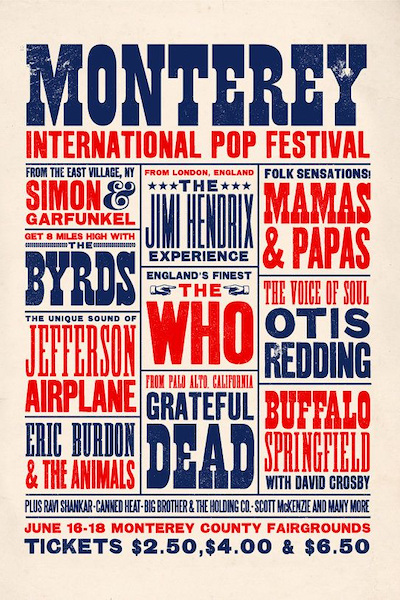
But two years before Woodstock was the original American music shindig, the one that may go in the history books as the most honest and true of them all. The Monterey International Pop Music Festival drew a couple of hundred thousand kids over its three-day span in mid-June 1967 to the seaside artist haven outside San Jose. Those lucky souls got to see the first major U.S. appearances by Hendrix and the Who, witnessed Janis Joplin prove that she was too big for Big Brother and the Holding Company’s britches — oh, and some guy named Otis Redding was there too.
Really, the reasons that festival may be the best ever, for all time, are too many to count. But we cobbled together a smorgasbord of reasons why Monterey will outshine any of this year’s countless carnivals:
1. No Ticketmaster fees.
2. No cell phones.
3. No sponsors.
4. Water didn’t cost money.
5. There was actual grass, not just dirt.
6. The audience didn’t need flash mobs or other insincere, contrived acts of social mobilization. Monterey attendees let the music itself – not just their peers – inspire them to shake their booties.
7. The Black Panthers and Hells Angels actually coexisted there. And the Angels didn’t get all batshit-violent, inspiring innumerable bad acid trips. Nah, they’d save that for two years later, at Altamont.
8. Appearance didn’t matter — not even if you were a musician. Cases in point: Mama Cass, Janis Joplin, and, to be fair, every member of the Who.
9. Roger Daltrey (and Jimi Hendrix, for that matter) had the whole flamboyant pretty-boy thing down waaay before the emos.
10. When dudes wore headbands, they weren’t trying to be ironic. They really meant it.
11. Face paint instead of henna tattoos. And the kids did it themselves.
12. The guys wore better pants. And the women wore hats.
13. Musicians could perform onstage and not get killed:
14. Including stars from other genres felt natural, not forced. Otis Redding, Ravi Shankar, etc. weren’t “token” additions — they had just as much to do with the spirit and meaning of Monterey as anyone else. Lollapalooza, Coachella, Pitchfork, etc. gratuitously add hip-hop and electronic artists, but they tend to feel like round pegs in square holes.
15. The drugs were better. They must’ve been. Grace Slick didn’t blink once during her performance of — how appropriate — “High Flyin’ Bird.”
16. The singers sang. And they meant it. No warbling. No sarcasm. No coyness. Just full-throated, true, honest vocals.
17. Ravi’s sitar can kick your drum machine’s ass. Shankar’s set was the equivalent of what you might find in the dance tent at Coachella. Except the music wasn’t synthetic and was a truly spiritual experience. Rather than pressing buttons and not engaging the crowd for 45 minutes, Shankar expertly strummed and plucked away at that thing for what seemed like an eternity. And he did it as a means of sharing communion with the crowd — something that isn’t real high on Paul van Dyk’s or Daft Punk’s agenda. And don’t forget, there is documented scientific evidence that drum machines have no soul.
18. Pets were allowed. What we would give to see dogs and cats crowd-surfing.
19. Try as they might, today’s festivals will never be able to book Jimi Hendrix. He played his guitar behind his back, chewed it, burned it, smashed it — used it up like a necrophiliac trying to find every possible use for a corpse.
20. Monterey meant something.
 The Bad Penny (beta)
Leave a comment