On Tyranny: Bobby Conn Doesn’t Mince Words About ‘Con Man’ Donald Trump
“The goal of fascism is control and power. That’s the whole thing. That’s it. There’s no ideology beyond that. … Maybe we’ll make it through this. But I don’t know for sure.”
-Bobby Conn

Chicago’s own Bobby Conn is a king among troubadours, a musician’s musician, and yet also a musician who fights for the people, á la Billy Bragg. His last name is perfectly ironic, as Conn is best known for speaking truth to power and dutifully serving as a protest musician since he started playing music in 1989 with the avant-garde group Conducent. Five years later, that band broke up and Conn embarked upon his journey as a solo artist, which resulted in eight studio albums.
His ninth, Bobby’s Place, just arrived in late August. It’s pretty far out there, dubbed a “split-personality” record in which the first half tells a fantastical story about him living on an astral plane, while the second half imagines him as the star of an alternative-reality workplace sitcom named “Bobby’s Place.” The project captures and sustains the eccentric personality that Conn has embraced throughout his career, which has showcased him as a performance artist, glam-rock devotee and unabashedly outspoken critic of American politics and culture.
When The Bad Penny interviewed Conn via video before the release of Bobby’s Place, he noted that it is his least political record to date. That said, he told Splendid Magazine in 2008 that “All the records that I’ve done are a critique of what’s going on in contemporary America.” And with that in mind, Bobby’s Place can’t be considered detached from reality, even if some of the storylines he tells take place in an alternate reality.
That debate aside, we invited the highly politically opinionated legend to participate in our ongoing series On Tyranny, and he graciously and enthusiastically obliged.
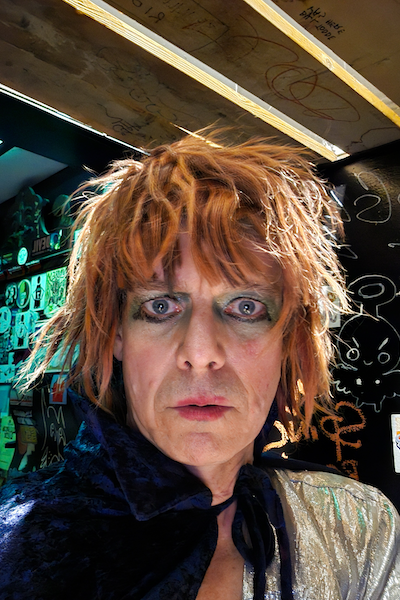
Thanks for chatting with me today, Bobby. It’s an honor. I dig your shirt. Is that Marc Maron featured on it?
No, it’s Richard Harris. My friend Robert Dayton from a great band he had, Canned Hamm, gave it to me. Actually, Neil Hamburger is the guy who first got me to listen to Richard Harris way back in the old days. As a punk-rock guy, he was, like, “You know what? If you want something really radical, check this out.” [It was Harris’ A Tramp Shining. I listened to it and] was like, “You’re right. This record is completely insane in a way that extreme punk shit [at the time] is not.”
So, your focus with this interview is rock and roll in the age of tyranny, correct?
Yeah. After the election, when it was clear he was going to be targeting journalists like every autocrat does when they try to consolidate power, I found myself at a crossroads: Do I just not talk about politics or do I really defend my beliefs? I chose the second route for a lot of reasons. One was out of moral obligation. Another was the realization that a lot of people who read my work and who are into the same music as me are insulated and not aware of what tyranny and authoritarianism mean.
So I started to interview bands from countries with authoritarian regimes and talk to them about what it’s like being an artist in those places, and use that dialogue to prepare American artists for what they might face, what they should do and how to try to survive it. Then, as things escalated here and college professors started moving out of the country, I shifted the series to also include conversations with American artists and how they’re now being affected. When I caught wind of your new album and its theme, you seemed like a really good candidate to participate in the series.
It’s funny, because for me, I feel like this new record is the least political record that I’ve ever made. With [1998’s] Rise Up! and [2001’s] The Golden Age, there were songs like “United Nations” and “The Golden Age” … even on the last record, [2020’s] Recovery, I had a song called “On the Nose” [in which I] deliberately tried to be on the nose [about my political beliefs]. I’m in my late 50s now, so I’ve seen the whole trajectory of politics.
One of the reasons why I’ve been political in my songwriting is because it’s something I’m not just bullshitting about. Also, aesthetically, the songs that I like the most in popular music were in the protest [realm]. I’m not a very romantic person, so I don’t write love songs. The Clash and The Dead Kennedys and Black Flag had a social critical angle that always was my jam more than party songs. But anyway, I’m glad that you think that this record has a political [bent]. My [last album,] Recovery, was released smack-dab in the pandemic, on March 20 of 2020 — the worst possible time to release a record. And it was a total failure. But part of my brand is total failure, so that’s fine.
When I started making Bobby’s Place, a guy [at German label Tapete Records] was like, “Maybe you don’t have to make a boo-hoo record every time.” So this is my attempt at making a more upbeat, optimistic record. I’m glad that you still detect that there is an undercurrent of despair and terror in it. That’s good.
I love the record. I spent last year depressed and anxious about this potential outcome [of Authoritarian America], knowing that if [Trump] won things would play out exactly as they have played out. The response I got from most friends and family was, “You shouldn’t watch so much news. Just keep your head down. You have no control over all that stuff.” That’s all well and good, but as a journalist with a set of core, sincere beliefs, I’ve hit my limit. So I’m finding a lot more connection with artists who aren’t necessarily on a high horse and saying, “I told you so,” but are still making records.
Oh, I’m definitely on a high horse. At shows, I’ve been saying, “I’ve been telling you this [shift to tyranny would happen] literally since 1995, and you haven’t listened. And now it’s too late” Part of the thing that’s become less fun is … back in the ‘90s, I postulated that because I was born in 1967, that put me at age 33, which was the age when Jesus [died], at the year 2000. And everyone thought that 2000 was going to be Armageddon. So I felt like there was a pretty good chance that I could be the Antichrist.
I played that out as best I could. I tried to prepare and tried to make a really good record because I thought, “If I have a really successful record, I’d get tremendous cultural power, and then I could move into politics and create a one-world government and fulfill the prophecy of the Antichrist.” As it turned out, I didn’t get any of the supernatural powers that would allow me to do that. So here I am, this marginal indie-rock guy [continuing to] warn people about the impending crisis in Armageddon that’s coming. And then this guy comes along. You’re old enough to remember Trump from the ‘80s.
Yeah. We had the Trump board game at home.
You know, that’s fucked up. He always came off as an obvious shyster con man, a completely untrustworthy and unserious person. Then, when I saw him cut like a knife through the mainline Republican Party, which he continues to do, I was like, “Wow, this is terrible.” He’s also cut like a knife through the very complacent liberal left. And this is the result. The song “On the Nose” [deals with how,] my whole life, I’ve been one of the guys who wants a revolution, to change things. But the revolution we got is actually a fascist revolution.
I work with a lot of young guys who are getting all their information from TikTok and YouTube videos. They don’t read books. They don’t read anything. And they’re asking me questions like, “What is a tariff?” And I’m just like, “Well, this is going to take a while [to fix].” Someone that has easy, knee-jerk solutions for every single problem, sort of like the guy at the bar that’s got an opinion about every goddamn thing, it’s very appealing because it’s a lot simpler than actually thinking through anything or getting information or listening to people. All those things take a lot of time. It’s a pain in the ass. So people don’t do it.
So that’s the situation we’re in, where we have a nation that is very eager to just be told what to do. And it’s depressing.
I really like what you just said, because people have a tendency to want to get their opinions from somebody who’s bloviating and doesn’t really know their stuff but talks the loudest. It intersects perfectly with podcast culture — that’s the unholy alliance that’s happened this time. When GW got elected, it was because the corporate conservatives and the religious right came together. Now you’ve got this younger bro podcast contingent who don’t have any men of character to look up to. I’ll stop talking so much after this, but I don’t accept when people say, “I have no time to read the news.” I ask them, “Well, how many hours a day are you on social media? Two? Three.
Just for the record, I would like to tell people what to do. I’m really sitting here as sort of a failed autocrat. I’m very jealous. I’m very envious because, as a thwarted almost-Antichrist, I see someone else succeed in that genre. It’s very personally painful for me. But anyway … what’s weird about America, though, is that … you shouldn’t be talking to me. I represent the least oppressed demographic possible. Part of the problem is that until people are like, “Oh, shit, I have to go to this internment camp,” people are just gonna be like, “Oh, I guess it’ll work out. I don’t know anyone that’s affected. So I don’t care. I’m just going to my job.” As long as that holds out, that complacently, [people might wind up] marching their way to the abattoir and get slaughtered at the end.
We’ve here in Chicago. Monica, my partner, has made friends with a 92-year-old, the mother of our dentist who survived the Holocaust. She was originally born in Germany and then moved to France. Her mother was taken away and died in Auschwitz. They weren’t taking away children from France. They only took the adults. Anyone from age 16 to 65, they took that demographic to the camps and the transports. But she made it to America and she survived.
She wrote this great memoir and [in it she details] seeing the steady progression of, “Well, first there was a law against this. Then there was a law against these people. It was very incremental. And at every increment, everyone that wasn’t directly affected was like, ‘Well, you know, I guess if I just keep to myself, I’ll be fine. The sun is still shining. The birds are still singing. I still have my job. I still have my house. So it’s probably going to be OK.’” That’s where that’s where we’re at in the United States right now.
I’m going to push back a little bit about your comment that you’re not a good person to interview for this series and say that I’m happy to be talking to you because you’ve studied the mentality of people living under an authoritarian regime. You have thinking patterns like an autocrat.
Thank you very much. Thank you for recognizing that.
How would you have done things differently if you had risen to that level of power?
Well, the main thing is that I’m not a sociopath. One thing that is really driving me nuts about the Democratic Party and the opposition is they keep thinking there’s like a specific grievance or policy agenda that’s driving this forward. And I’m like, “No, you don’t get it. The goal of fascism is control and power. That’s the whole thing. That’s it. There’s no ideology beyond that.”
So, when you’re dealing with someone that styles themselves as a supreme leader and an absolute leader, then everything they do is to achieve more absolute supremacy over every single person they encounter at all times. That’s why they’re trying to win the daily news cycle every single day, because that’s the plan. They’re not thinking, “Oh, what are we going to do in six months?” They’re going to win every single day. That is a hard thing to wrap your head around and strategize around because it puts you in a very reactive mode at all times.
[They ask themselves,] “What can I do to consolidate power every single day, every single time and smash my enemy every single day, every single time?” That is very simple. Fascism is simple because anyone that opposes you, you crush them. It doesn’t matter what they’re saying, it’s just the simple fact that they’re in opposition. There’s no logic to work around it. I mean, there’s the racism, the xenophobia, the hatred, the “othering,” the hatred of LGBT people. All those things are just tools to create opposition that you can crush.
Divide and conquer. Demagoguery.
Yeah. It’s just a question of when enough people in this country decide that’s not what they want to live with, because it is all-consuming. But what can you do? This is the time we’re living in. And it’s a bummer. Maybe we’ll make it through this. But I don’t know for sure.
Buy a copy of Bobby Conn’s Bobby’s Place on his Bandcamp page.
Go here for The Bad Penny‘s On Tyranny hub.
 The Bad Penny (beta)
Leave a comment