Dying Remains Debut With a Vengeance, Are ‘Meaner’ Than Bolt Thrower
Talking with a band on the day their album comes out is exactly the same as talking with a 10-year-old ripping wrapping paper off boxes of gifts on Christmas Day. It’s unadulterated joy. Unless maybe the band found a defect in the packaging, or that the tracks were listed out of order, or that the artwork is wrong. Anyway, you get the drift.
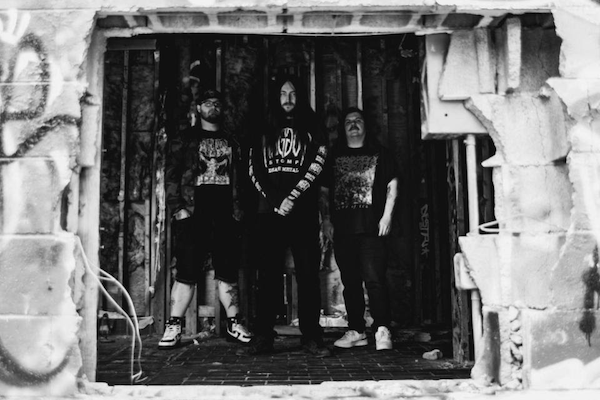
The Bad Penny had the good fortune of catching up with the gleeful gang that comprise the similarly jovial-filled band named Dying Remains, death-metal darlings who hail from Calgary, Alberta, on the day their new album came out. In fact, Merciless Suffering isn’t just their latest record: It’s their first-ever full-length, following warm-up releases Entombed in Putrefaction (an EP from 2023) and the split Dead & Buried: A Death Metal Compilation that appeared in mid-June.
California death-metal label Maggot Stomp – which has also released records by 200 Stab Wounds, Frozen Soul, Coffin Rot, Vomit Forth, Ossuary, Tribal Gaze and Internal Bleeding – have been the Mickey to Dying Remains’ Rocky Balboa throughout the entirety of their still-nascent career.
Maggot Stomp is championing them as TNBT on their label if not across the death-metal scene on the whole, and it doesn’t take more than a listen to Merciless Suffering to understand why. Guttural, deliberate and catchy through and through, the record is the soundtrack to the lives of those of us who can’t wait for ours to end.
On that note, enjoy our whimsical, innocent and uplifting conversation with Dying Remains’ vocalist/guitarist/bassist Damon MacDonald, conducted a month ago while they cradled their new baby in their arms.
Pretty big day for you guys with the release of Merciless Suffering, right?
Yeah, man. We’re very excited, very happy. Been waiting since what feels like forever to finally put it out.
When you say it “feels like forever,” is it because of the length of time it took to create the record or just because, when you get really excited about something like this, time seems to stretch out forever?
A bit of both, really. We started writing the record pretty much right after we finished the EP [2023’s Entombed In Putrefaction] and slowly started chipping away at [Merciless Suffering]. Then we started picking up more Canadian tours and shows, so we didn’t have as much time [to work on it]. We took our time with writing and wrapped that up in October 2024. Then we started recording during Christmas. From the time we finished writing to when we tracked it, that went by really fast. And now we have the final product, so we can [finally] celebrate.
Can you tell me a little more about the final stages of the record’s creation?
Scott [Oliphant], our guitarist, did the mixing and mastering. We record it with him because he has a studio. So we went in just before Christmas and finished everything around the end of January, somewhere around there. The whole process took about a month, five weeks.
It’s awfully advantageous to have your own recording studio in this day and age, no?
Oh my God, it’s so nice. Scott is a wizard with that stuff. I don’t really know much about recording. I know how to record instrumentally. But Dimitri, our drummer, knows a little bit. So like those guys talked while I just sat there waiting to play or track or listen back to stuff. [We laugh.]
Also in terms of the expense of booking studio time and all that.
Oh yeah. We got very lucky with that too. We’re gonna buy Scott a very lovely dinner when we get home as a little thanks.
So probably somewhere fancy like Cracker Barrel, huh?
[We laugh.] Maybe! We went to In-N-Out last night. Maybe I’ll buy his In-N-Out today, and we’ll call it even. It’s an exciting day.
Well, for a second here, let’s go back to 2023. That’s when you played your first gig, right?
Yeah. Our first show was August third or fourth with Defeated Sanity and Stabbing. They were on tour together. And we were lucky enough to be able to jump on that. I thought it was a festival!
That’s quite a way to start a career, playing with legends like that. Did you start getting ideas from that point forward about what you wanted to bring to your debut album? To what extent did it meet your expectations? And to what extent did it kind of become something different than what you thought it would might be?
Shortly into the writing process of the record, we got a vision of the record. And it held up. Halfway through writing the record, we decided we wanted to do something more mid-tempo. Let it be slow and hang out. We wanted to write these, like, big, greasy riffs.
And then, I think we were on the third or fourth song into writing the record and we’re like, “You know what? Let’s just write how we feel we should write for the record, what feels natural, and maybe not try to limit ourselves totally to just the one thing.” Because the EP is slow, we really liked it. You’ve heard the record at this point?
I love it. That’s why I’m talking to you, haha.
Haha. Yeah. So a song like “Upon the Torture Rack,” it’s really fast. That was a song that Scott brought to the table. I think that was the first song that he wrote for the record. Scott joined the band later. But he fits the bill pretty well with us.
We were pretty excited when he wrote the song, and it was nice to have somebody else’s input and take too, because me and [drummer] Dimitri [La Rose] have been writing together for like, almost 10 years. So to have somebody like come in and be like, “Oh, hey, how about this? It still lines up in the same style of what we’re doing, but it is a little different.” It was, like, “Awesome.” It added dynamic and variety into what we’re doing.
So basically, we wanted to take what we had originally with the EP but push it a little further. And I think we hit that mark. So really, the vision of the record never really changed. But the end result of how we got there did. And that’s gonna happen as you write. But that’s fine. We love [Merciless Suffering].
As well you should. It’s a tremendous record.
Thanks.
I’m always fascinated by situations in which two members of a band have a longstanding relationship and then wind up writing with somebody else. When you brought in Scott, to what degree was it hard to allow a new, creative voice to assimilate into what relationship you already established for 10 years?
It was a learning curve, for sure. On my end particularly, because it’s been a long time since we’ve written with somebody else. Because usually it’s just me and Dimitri, I would write the riffs and bring them to him, and we would sit down together and hash it all out, figure it out. To have Scott come in with his ideas was interesting.
The first couple months, he needed some time to really lock into what we were doing. And what we thought was good, like how we felt about riffs and stuff. So he adapted to what we wanted to do, because he comes from a different background of death metal. He plays a lot more technical stuff. He’s a very talented guitarist. Dimitri is a very talented drummer.
I’m not like the most talented guy in the world. I just like to make weird riffs, but they’re not really technical [from] any standpoint. So to have [Scott] come in with some bigger ideas than what I had, it was interesting, but it was also trying to find the line of what was too much and what was too little. And Scott really took well to that. He figured it out very quickly. And then he brought us “Upon the Torture Rack.” And we were, like, “This is great, dude.”
Personally, I’m quite surprised that the death metal resurgence has lasted as long as it has. It seems like it’s been five years or so now. I know, as a critic, it’s lazy for me to talk about subgenres and all that shit. But to what extent do you feel like you’re bringing something new to the table amid this sea of new death-metal bands?
I think we just have our own take on it. A lot of the bands in the resurgence era have their own spin on things. Like, look at Tribal Gaze and Frozen Soul. And obviously box 200 Stab Wounds. They all have this very unique twist on what they’re doing with death metal. I think we have the same thing going in that we are very rooted in ‘90s old-school death metal, especially the more mid-tempo stuff, like Jungle Rot, Obituary, Sorrow — and Morta Skuld [whose 1993 record was titled Dying Remains].
It all comes from the background of what you’re influenced by that makes that spin on your music. So, Frozen Soul – especially Bolt Thrower, like, huge – and even Jungle Rot, you can hear it in there. I think that’s very interesting, because when they came out, there wasn’t really much Bolt Thrower worship happening anymore. And I think that really helped them. Our stuff is meaner, because it is a little slower and caters to what we were thinking of doing the whole time.
Did you have any issues getting into the States when you played your first tour here recently?
No, there was no visa issues, surprisingly. We were super-nervous when we rolled up to the border, because we’d never done it before. So we were just like, “What do we do?” We have this folder with all our paperwork and stuff, and we handed it to them nervously. We sat there for like 35 minutes … and then that was it, and we were out of there. It was super-routine. We had like this big idea worked up in our head that it was going to be terrible, but it was actually very pleasant.
What was your favorite aspect of playing the U.S. for the first time?
Honestly, man, kind of everything. I had wanted to come play music in America for 10 or 12 years, so finally getting there was awesome. The first thing we did when we got over the border was go to McDonald’s. The menu was crazy. We’d never seen anything like it. There were chicken strips on the menu! We were, like, “What the fuck?” And you buy a burger for a dollar? In Portland, the guys in Coffin Rot brought us to a place called Portland Burger, and that was really cool. We tried In-N-Out; we don’t have anything like that near us.
But just being on tour and meeting a bunch of really cool people who like our music was the coolest thing. Sharing that connection with people, and to see people enjoy the stuff that we enjoy and that we put a lot of time and heart into was really fulfilling — especially somewhere we’ve never been before. In Canada, we know everybody, so most of the time when we play shows out there, it’s the same people.
Who are your closest bros?
There’s a band called Snakepit from Calgary. They’re, like, our best friends. Most of our Canadian tours we’ve done have been with them. We just love hanging out with those guys. Then there’s Congealed Flesh from Calgary, Pre-Breaker from Edmonton … there’s so many bands we love. Scott actually lives with two-fifths of Snakepit, so we get to see those guys quite a bit.
Well, we look forward to you returning to the States — assuming it’s still standing.
Thanks, man!
Learn more about Dying Remains on their Bandcamp page and grab a copy of Merciless Suffering on that site or on Maggot Stomp’s distro page.
 The Bad Penny (beta)
Leave a comment