From the Vault: The Rising – The Hero and the Victor
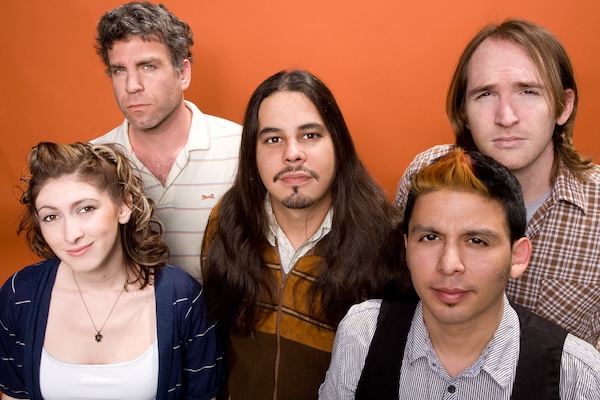
Alan Lomax, who passed away at age 87 in 2002, will likely go down in the books – or the Kindles, or whatever – as one of the most important figures in music history. The late, great ethnomusicologist captured the essence of countless cultures as they manifest themselves in sound. He created “field recordings” – the primal beat of humanity itself; and compiled “oral histories,” the narrative counterweights.
But beyond Lomax, it’s rare to find points where anthropology – at least in the academic sense – and music meet.
Enter David M. Mendoza, a cultural anthropologist, elementary-school teacher – oh, and rock-band frontman – who is as eager to talk about music as he is ancient Mayans who predicted that the world would eventually be overcome by galactic drift.
Sometimes music needs a fresh glass of brain juice, and Mendoza is the kinda guy who could be squeezing it.
“We all work together to send out messages that mean something to us first, and to other people as well,” he tells IndiePit about his band, the Hero and the Victor. “Individually, we stand on our parts, and as a collective, it creates a social message.”
Still, Mendoza is careful to qualify: “The key thing is … if you get too caught up in a message, it doesn’t mean anything anymore. You can over-think the message.”
Most singers – often for fear of sounding too didactic – aren’t so forward about their music having a “social message.” But when you think about it, how can a band not have one? After all, what is a concert but a collection of human beings receiving audio and visual inputs from other people who happen to be on a stage? In other words, if a band doesn’t have a message, should it even exist?
Chew on that one later. For now, meet Mendoza’s clan, a post-punk-tinged tassel of five who hail from Santa Barbara, California. Sounding like a crew that could’ve just as easily come out of D.C. in the late ’90s, THATV lean heavily on syncopated beats, multiple guitar lines volleying back and forth, and brittle riffs that are constantly on the verge of exploding.
Despite having three members who sing – guitarist Mendoza, guitarist Gabriel Clark and bassist Tyler Hegner – THATV’s music is predominantly instrumental. More often than not, when you’d expect to hear some words at a transition, you hear a new wave of guitar instead.
Or even less. “We make silences be part of our music too,” Mendoza adds. And indeed, one of the greatest strengths of the band – which also includes keyboardist/percussionist Angie M. Bertucci and new drummer Angus Forbes – is how it uses empty space in its favor (cf. Godspeed You! Black Emperor, Mogwai). The distended “Spin the Globe” is almost all buildup till the drums start crashing at the 4:30 mark. And the vocals don’t enter till a minute after that.
Those drums, by the way, don’t belong to Forbes. He’ll be making his THATV recording debut on “MVP,” one of two tunes the band will be dropping July 23 via iTunes and other outlets. The second is “Transmission,” a hats-off to David Bowie (is the “Transition/transmission” chorus from the Thin White Duke’s “TVC 15” coming to mind?).
“There’s actually a message at the beginning of it, which is cool, because if you read Morse code, you’ll be able to understand it,” Mendoza says.
Leave it to an anthropologist to pull off a stunt like that.
Down the line, expect both tracks to resurface on THATV’s next, yet-untitled album. The effort won’t be their first; the core bandmembers have been playing for seven or eight years now and have pumped out a steady stream of “honest, expressive, no-rules rock,” per their avowed mantra.
And as those years have come and gone, Mendoza has fine-tuned his own personal mantra – which, as it turns out, is inextricably connected to the theme of the band.
“You fall of the ladder sometimes, ’cause nobody’s perfect. But one of the best things to do – since it’s hard to make everyone happy, including yourself sometimes – is trying to decide where you’re going to be and how people are going to read you just by the way you. It’s one of the questions everyone should ask themselves.
“Taking responsibility is kind of the hardest thing to do sometimes,” the frontman continues. “You could be the hero or the victor – or you could be the leader.”
[This article was originally published on IndiePit in September 2009.]
 The Bad Penny (beta)
Leave a comment