Kayo Dot Meticulously Dots All the I’s, Crosses All the T’s on Fierce New LP
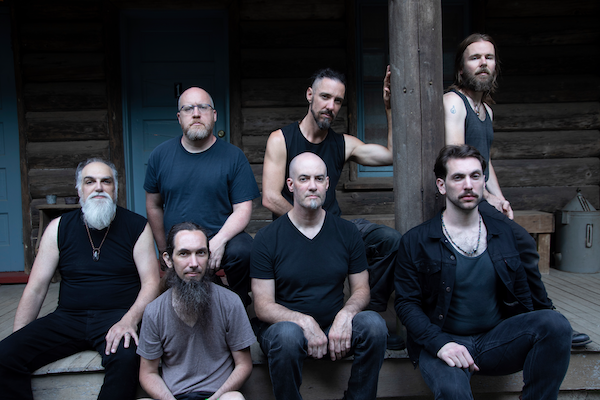
Kayo Dot may be a blip on the radar when it comes to the universe of music, but for those enough to see and identify the avant-garde metal from Boston, they are a North Star of artistic brilliance. They occupy a throne among metal’s noblemen. They are intellectual to the core, a fact of which listeners are reminded with each stroke of musical brilliance that emanates from their collective strength as true artists.
Every Rock, Every Half-Truth Under Reason (Prophecy Productions), released Friday, proves these statements of fact through and through. It’s a strong and focused artistic statement, executed with precision, and full of innovative ideas that go far beyond what most metal bands are even attempting right now. That alone is a lot to be proud of.
Every Kayo Dot album aims to explore new artistic concepts and technical approaches—it’s the best way to grow both as an artist and as a human being. That commitment to evolution is central to the goals of this and all of their other previous records.
Vocalist, guitarist, bass guitarist, keyboardist, instrumentalist and fire-breathing lion tamer Toby Driver spoke with The Bad Penny recently about the heart and soul of Kayo Dot, and why this year is a celebration of sorts for a decades-old yet still remarkably relevant record by the blisteringly brilliant band.
The gap between those two records is the longest one since you issued your first release in 2003. Was COVID entirely to blame for the delay? Were there other mitigating circumstances? Or did you simply feel like it was the right time to more patiently and carefully craft a Kayo Dot record than ever before?
The boring but accurate answer is that the pandemic was almost entirely to blame. COVID—and all its cascading effects—left me completely displaced, without any centralized location or proximity to other band members. Even now, I’m not entirely sure where the band is technically “based.” That said, I had a collection of song sketches as early as 18 months before completing this album. But as I worked through them, I realized they weren’t what I wanted the record to be. So I shelved them completely. In that sense, making Every Rock, Every Half-Truth Under Reason was like making two different albums. Those earlier ideas might resurface one day—but this record needed to become what it became.
Is there a thematic relationship between your last two records, or was it pure coincidence that one had “Moss” in its title and the name of its followup contains the word “Rock”?
I think that’s a stretch. As with all Kayo Dot albums, I’d encourage you to look deeper.
What came easiest to the band in the making of Every Rock…? What was the biggest challenge you faced during the process?
Nothing about it came easy. But after months of searching, the vision finally came into focus. From that point on, the process became more fluid—I shifted from being a seeker to being more of a guide or shepherd. The biggest challenge was finding something truly innovative that still felt natural and inspired—avoiding cheap tricks or empty gestures. The older I get, the harder it becomes to find the right voice for Kayo Dot—a band that began over two decades ago when I was in my early 20s. How do you stay true to an essence without falling into nostalgia or self-parody? Especially in a genre like metal, which is so bound to its own tropes. That tension is always there.
While music genre labels are almost always too simplistic or a crutch that minimizes an artist’s work, “experimental” is a broad enough term that seems to allow and even encourage more artistic freedom than most other music genres. Heading into the making of Every Rock…, what did you want to experiment with the most? Were there certain boundaries you wanted to push, and if so, how did you go about doing that?
One of the central goals from the beginning was to subvert traditional forms of rock music. I approached this with an awareness that rock is now about 80 years old, and metal more than 50. I still wanted to access the emotional power those genres can deliver, but to do it without relying on familiar patterns. Sometimes that meant something as simple as avoiding a backbeat entirely. Other times, it meant more intricate and deliberate transformations of those kinds of tropes.
Did the end result of such experimentation—or simply the album itself—surprise you in any ways? Was the final version of Every Rock… a far cry from what you initially envisioned (to the extent that you had at least some semblance of a vision going into the making of the record)?
Absolutely. As I mentioned, I originally started with an entirely different batch of music. Those early versions emphasized rhythm and percussion, but they weren’t really accomplishing anything meaningful. They didn’t feel like a step forward. So I kept starting over—recording, deleting, refining, reducing. That intense process of elimination eventually revealed what the album wanted to be. And yes, the final result is vastly different from where I began.
Did you intend for Every Rock… to have a conceptual theme running through the entire record, as you did with Coyote? If so, why? If not, why?
I always work closely with Kayo Dot’s lyricist, Jason Byron. My focus is on musical concepts and how they express a particular artistic or philosophical idea—especially in the context of musical history. Jason’s role is to translate those abstractions into something more linguistically accessible. He’s a brilliant storyteller and naturally drawn to narrative. So together, we create a dual-layered concept—musical and literary—that reinforces itself in both directions. All Kayo Dot albums are conceptual in this way, though not all are narrative. I think a cohesive vibe is always important—it defines the world the album inhabits.
Did you incorporate any instruments into the making of this record that you had never included on a Kayo Dot album before?
Not exactly. Everything used here already exists within the Kayo Dot universe, though many elements are presented in new ways. And a few are presented in old ways too, calling back to [2003’s] Choirs of the Eye since this is, in a sense, an anniversary album. We did alter tunings extensively—as always. And we used a few custom-made instruments for the sake of live performance. One example is a hybrid guitar-bass instrument built by our drummer Sam, tuned specifically to cover a lot of ground with just one player. It’s not a super farfetched instrument, but it solves real-world performance challenges creatively.
Would you say the most pivotal and/or perhaps disconcerting point in Kayo Dot’s existence was in 2006, when a litany of lineup changes occurred? It was at that time the band scaled down from an octet to a group with only three formal official members of the band, correct?
No, not at all. That was nothing in the grand scheme. Lineup changes are common—for Kayo Dot and for any band with longevity, especially in niche music led by a single auteur. There have been far more consequential turning points over the years.
You’ve alluded to Every Rock… returning, at least in part, to Kayo Dot’s roots. Which particular elements of your earlier sound did you want to rejuvenate, and which did you want to avoid repeating?
There are moments on this record—especially in the orchestration and melodic development—that intentionally recall Choirs of the Eye. I also wanted to re-engage with some of the classical and experimental approaches we used in our early years, especially when it comes to flexible time. That stands in contrast to the second decade of the band, which leaned more heavily into rock-based structures and rhythmic counterpoint.
At the same time, it was essential not to simply repeat ourselves. For all of its innovations, Choirs is still tied to the early 2000s and the post-metal / post-hardcore scene—what some call the “Hydra Head sound.” That aesthetic feels dated now, and I don’t think rehashing it would be interesting for anyone—including me.
Buy Every Rock, Every Half-Truth Under Reason on Kayo Dot’s Bandcamp page. The gang is planning to back the release with performances in Europe from Aug. 26 through Sept. 18.
 The Bad Penny (beta)
Leave a comment