Pet Sounds #58: Sally Anne Morgan’s ‘Circle’ of Friends Includes Sheep, Chickens, Cats
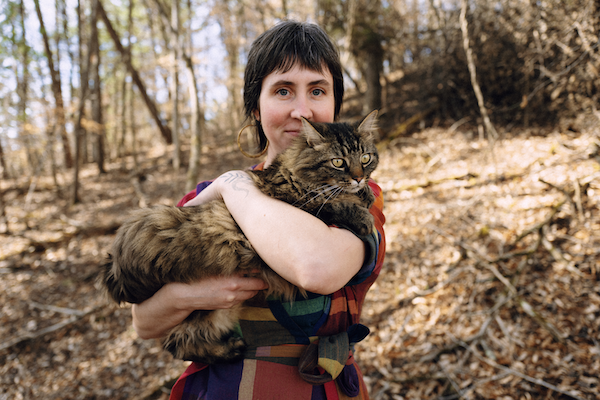
Anyone silly enough to believe that artists only live in cities in the U.S., we bring you Exhibit A in refutation of that erroneous claim: exceptional music talent Sally Anne Morgan. The thoroughly relatable musician and artist refers to her music as “psychedelic Appalachian folk drone,” which might seem tough to understand – until the moment she begins to play.
Signed to one of the most respected indie labels of the past 30 years, Morgan has a home at Thrill Jockey Records that is almost as comfortable as the 3-acre pasture she shares with her husband in North Carolina. While it’s true that The Bad Penny has mostly interviewed urban-dwelling artists about their animals for our ongoing Pet Sounds series, we had the pleasure of learning how a musician surrounded by animals at all times finds their creations inevitably impacted by nature and the creatures that dwell in it.
Earlier this year, we caught up with Morgan ahead of the release of her tranquil, meditative and soothing new album Second Circle the Horizon before it came out late last month. What follows is a condensed version of our invigorating conversation.
Hi, Sally. Many thanks for speaking with me today for Pet Sounds. First things first, though: What a magnificent background in the room you’re in. Is it part of your house?
Yeah, this is my letterpress studio. I make greeting cards and put them on old printing equipment that is kind of obsolete but also charming.
Is that where you came up with the album cover for Second Circle the Horizon?
I would say it’s an extension of that.
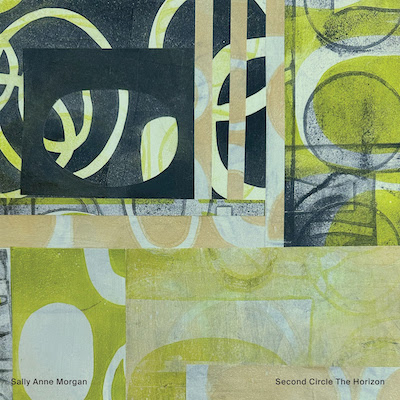
I got into letterpress like a decade ago, started my own business and somehow have managed to make a living doing that. I’ve sort of compartmentalized it as, “This is my business. I’m trying to make money with it.” Music is another compartment where I’m like, “I’ve given up any idea of making money.” I still like to mess around with visual art, and started doing other kinds of printmaking, mostly for fun. It’s called monoprint. It’s sort of like painting-meets-printing. I’ve been collaging with those.
Do you sell your art on your own website or Etsy?
I sell my greeting cards on Etsy, and I do a lot of wholesale stuff. I sell to bookstores and garden shops and coffee shops. I haven’t ever really sold the collage-type things, but maybe someday that’d be cool.
What was your first artistic passion?
I feel like I’ve always been into drawing things, even as a kid. I did play music as a kid, but it never felt like art. It always felt like the teacher telling you what to do. “This is the orchestra.” “You play these notes.” I’ve always been into making things.
Do you feel like the way you approach your visual art, with a sense of collage, is similar to the approach you take to making your music?
[On Second Circle the Horizon], for sure. The collages are so similar to how I come up with music. It’s all about balance and composition. And I don’t mean composition as, like, I’m composing a score or a symphony. With the collages, I think of it more like, “Can I put this here? Or do I put it here?”
I’m so grateful to have been able to listen to your record a month and a half before everybody else, because I’ve really fallen in love with it. And I see what you mean about your artistic approach to making music. The composition is the result of pieces coming together. It isn’t fully improvised or fully composed.
I just start with something, and it’s never written down, and it’s never really planned out. It’s really in the doing of it that I make the piece.
And you brought in your collaborators later in the process, right?
Yeah. I had finished the bones for all the pieces, and I asked Brian [Weitz, better known as indie-rock artist Geologist], who plays hurdy-gurdy, to play on one of these pieces [“Dog’s Dream”]. After I was done [and felt good about how it came out,] I teamed with Sean [Dunlap, who plays synthesizer on “Calico Summoning,” “Night Mint” and “Callahan”]. I felt like those three songs needed something else.
I used to play, and still do play, string-band music with [another Thrill Jockey band], The Black Toy Pickers. We try to capture the essence of us playing together. And we’ll only play through a tune a few times.
That must really allow your band to engage with nature, Emerson-style.
The word I use is “organic,” because it’s not an electronic way of making music. And there can be random sounds in nature that become harmonious altogether – especially the more you listen. It’s like the epitome of beauty to me, hearing all that. I am not a purist. I live [outside Asheville in North Carolina], which is in the country. There’s the bird songs, but we have a lot of cicadas right now, and there’s cars driving by that are not part of nature.
This time around, did you discover anything new in nature that you hadn’t before? Or anything in yourself that you hadn’t before?
Ooh, that’s a really good question. I feel like this was more about going deeper into things I was already discovering or had already discovered. When I recorded [November 2021’s] Cups, I felt pretty tentative because I’d never done anything like that. It was outside of the songs and traditional music I’d done before, and was also me recording myself, and I wasn’t super-confident that I was placing the microphones correctly, that sort of thing. But I felt like the reception was good enough that I was like, “OK, maybe I could do it again, just with more confidence.”
All right, so I can almost hear the readers anxious to get to the part of our conversation involving animals. You have at least one dog, right?
Actually, I have two. They’re both great Pyrenees mixes. One of them is this guy here. He likes this cold concrete floor. The other one, who’s knocking at the door, is an Anatolian Shepherd mix.
On Second Circle the Horizon, you have an encounter with a heron, and then a sheep comes into the mix too, right?
Yeah. So, my husband is from Michigan, and points out herons to me wherever he sees them. So now I always see them. We actually named my second son Heron. Also, a band I really love is called the Incredible String Band, and one of their band members is named Mike Heron. “I Saw a Heron” is actually a fiddle tune. I was trying to make a fiddle melody that sounds like an Incredible String Band song. And it doesn’t at all.
Our older son actually helped name [his brother]. We don’t even remember presenting it as an option, but he picked up on it.
How does the spirit of the song capture the experiences that you’ve had with herons?
Well, it starts with that fiddle melody that I recorded, and then I wanted to mess around with it and make it better. I decided to add piano, and it’s like the piano almost overcomes the fiddle and has this visionary spirit.

So now, can you tell me more about the sheep?
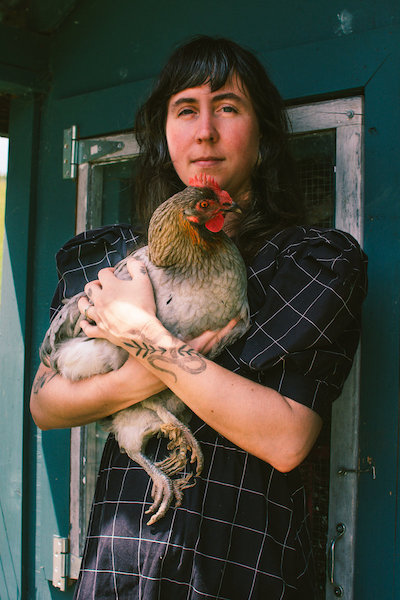
Yeah. So we have sheep on our 3-acre pasture. I sometimes call us “hobby farmers.” I don’t even know if that’s really right. We have a garden, we have sheep, we have chickens. We don’t make money really doing anything. But we eat eggs, and I get the sheep’s wool spun into yarn and try to sell it – but it really barely covers the cost of the sheep.
Sheep tend to give birth on really cold days. Some people say it has to do with the air pressure, but there was a really cold day in January, and a sheep’s mom … I wasn’t expecting her, like, lambing to happen, but all of a sudden I saw there were these two little lambs. Her name is Loretta. She was not doing well. And it was actually our first season lambing, so we didn’t really know when we needed to bring her inside.
She was almost comatose. She wasn’t moving, and I was sure she was going to die, but we were like, “OK, let’s bring her inside and get her warm.” I looked at YouTube videos on what to do for a lamb. We [eventually] had to inject her stomach. Basically we made a glucose solution, and I feel like it’s pure luck that she survived, because neither of us are trained. Oh, and it was three in the morning, so we couldn’t get a vet.
Anyway, she did survive. She became a bottle lamb. ‘Cause after you bring them in and they have their mother, mama lamb doesn’t want her back. She tried to head butt her anytime we tried to put her up to nurse! Even though she lives with the rest of the sheep now and is like 4 years old, the rest of the sheep will run away from us, but she’ll come say hi.
Did you actually record some of Second Circle the Horizon in natural environments outside? Or did you do it all in studio?
It was all inside – but in a cabin in the Smokies. I did an artist residency program in Northern Georgia a couple of times. So it was perfect. I love it there.
Last question: Do any of your animals make an appearance on Second Circle the Horizon?
No. That would be cool. There’s something really magical to me about the sound of sheep chewing. It’s a very gentle chewing of grass. I should really pursue getting a recording of that. Thanks for reminding me!
Pick up a copy of Second Circle the Horizon here.
Go here to read the previous installment in The Bad Penny’s lengthy Pet Sounds series, in which BC Camplight relied upon his adorable dog, Jug, to build up the courage to get sober.
 The Bad Penny (beta)
Leave a comment