From the Vault: Michael Jackson And Kurt Cobain, Suicide Kings?
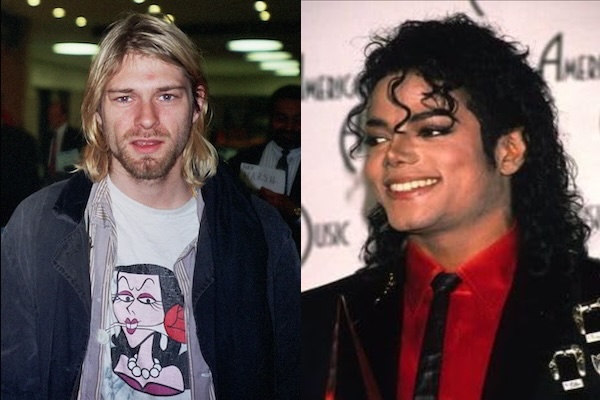
With July 4 fast approaching, it seems fair to say that the real fireworks happened eight days ago, when the country lost someone who has quickly become regarded as something of a patron saint. Much to Jon Stewart and Stephen Colbert’s chagrin (see below), the coverage has been ceaseless since that Thursday afternoon, and will almost certainly continue unabated at least until the details of his death finally congeal.
But while it’s hard to flip on the tube and not see an image of Michael Jackson, someone else keeps getting resurrected in my mind.
I speak, of course, of Kurt Cobain. The man whose band toppled Jackson from the #1 spot on the Billboard chart in January 1992 – delivering the star a pop-culture blow from which, some would argue, he never recovered. From that point onward, the self-described King of Pop only had one major single. And that’s not to mention the cascade of personal problems that accelerated early the following year, when Jackson was first accused of child abuse.
But at the time Nirvana’s Nevermind dethroned Jackson’s Dangerous, Cobain wasn’t at the top of the world: He was unraveling. In fact, as Charles R. Cross detailed in “Heavier Than Heaven,” on January 12 of that year, Cobain overdosed on heroin at the Omni Hotel in New York.
Another OD happened two and a half years later – on July 17, 1993 – and during the incident, Courtney Love revived her husband with help from an illegally acquired prescription drug, Narcan. And we all know what happened the following April.
The details surrounding Jackson’s death are still coming to light, and it is not known whether he deliberately overdosed. But it is alleged that drugs – prescription ones in particular – played a role in his demise.
The remaining parallels between the two men – the king of the ’80s and the king of the ’90s – are almost too many to count:
-Jackson grew up in Gary, Indiana, a city whose economic depression was only overshadowed by its reputation as the murder capital of the U.S. Cobain was raised in the blue-collar city of Aberdeen, Washington, which suffered economically for decades as its only real industry – timber – shriveled up.
-Both had estranged relationships with their fathers. And while it’s not a savory point to make, it could be argued that those father-son tensions fueled both artists’ careers.
-According to “Heavier Than Heaven,” Cobain drew a picture of Jackson in one of his classes. The image was deemed inappropriate because it showed the celebrity clinging to his crotch.
-Both stars’ stage antics were stuff of legend. Cobain destroying his guitar at the end of every show, Jackson going through pyrotechnics as if they were 10-cent firecrackers.
-Each star sided with “the other.” As Cobain reiterated in many interviews, he defended a gay classmate – and, later in life, would help gay-tolerance efforts by appearing on the cover of The Advocate. And say what you will about the life Jackson led: His songs did more for ethnic, racial and cultural tolerance on a global scale than probably any other entertainer in history.
-Neither star could sustain not just their own health but healthy family lives. Both married problematic women, and neither will have played as large a role in their children’s lives as did their own fathers, whether they reviled them or not.
-Each had an infamous news article that would haunt them for the rest of their lives. For Jackson, it was the one that originated the term “Wacko Jacko.” For Cobain, it was the Vanity Fair piece that he and Love actively used heroin while their child was still in the womb.
-It was hard to take either man at his word. “I usually am enjoying myself, and I’m hardly ever depressed,” Cobain said without a trace of irony in an interview conducted by Michael Azerrad that surfaced in “About a Son.” For his own part, Jackson knew that his statements were not ringing true with the public. “People would say … ‘You can’t believe a damn word that comes out of his mouth,’ ” Jackson said of what he thought people thought of him, according to J. Randy Taraborrelli’s 1991 book, “Michael Jackson: The Magic and the Madness.” Jackson would later declare in 2007, “I would not change a thing about my career,” according to USA Today.
-When Nirvana won the award for Best Alternative Music Video at the MTV Music Awards in 1992, they sent a Jackson impersonator up to the podium to collect the honor. “You know, it’s really hard to believe everything you read,” Cobain later added about the band’s prank.
-Both musicians loathed the media. “They’ll believe anything you say, because you’re a reporter,” Taraborrelli quoted Jackson as saying. Cobain, as he says in “About a Son”: “I want to beat them to the death. I’m a firm believer in revenge. I think there’s a time and place for violence in any situation. … I don’t enjoy people fucking with my family. … They’re the most ruthless life form on earth, journalists, the evilest, most uncaring fuckheads, the most bitter people I’ve ever known. They’re just – they suck, I have absolutely no respect for anyone who’s a journalist.”
-Maybe in response to the media attention, each man receded into seclusion, drifting further away from the public as they came closer to their respective demises.
-Leading up to their deaths, both stars metamorphosed into frail versions of their former selves – manifestations of their increased depression and drug use, it could be alleged.
-It will never be known if Jackson, had he lasted, could have survived what was shaping up to be an exhaustive, 50-date tour. Some reports have claimed he was intending to cancel or postpone at least some of the shows. Cobain, on the other hand, reportedly either broke up or was about to disband Nirvana prior to his death.
-The public was stunned by each man’s death – deaths that were undeniably predictable.
-Fans flocked to sites – Neverland Ranch and Seattle – to mourn and seek answers.
And here is where the two stories diverge. As the incessant media coverage continues into the holiday weekend, I don’t remember the Cobain story lasting for more than a couple of days. Sure, cable news wasn’t as dominating in 1994 as it is today, but I can’t seem to remember any media outlet other than MTV covering the story in a sustained way.
Let’s not forget the treatment Cobain received in the wake of his death. Fault him for abandoning Francis Bean. Fault him for being a junkie. Fault him for taking his own life. But are we really to overlook Jackson’s shortcomings (to put it mildly), apparently out of politeness during a sad time, as much as we were told to focus on what made Cobain such an evil man?
As Andy Rooney, who later apologized for these remarks, said unforgettably:
“A lot of people would like to have the years left that he threw away. What’s all this nonsense about how terrible life is? What would all these young people be doing if they had real problems like a Depression, World War II or Vietnam? If he applied the same brain to his music that he applied to his drug-infested life, it’s reasonable to think that his music may not have made much sense either.”
Mr. Rooney, I hope on this Sunday’s “60 Minutes” that you plan to dethrone Jackson with the vitriol you did Cobain.
Did both men give up on their lives? In the case of Jackson, we still don’t know – and maybe never will. But while the cable-news networks continue feasting on this coverage opportunity like ants on a discarded piece of bubblegum, let’s try to keep some perspective.
[This article was originally published on Indiepit in 2009.]
 The Bad Penny (beta)
Leave a comment