From the Vault: Exclusive – Russian Circles’ Track-By-Track Tour of Geneva
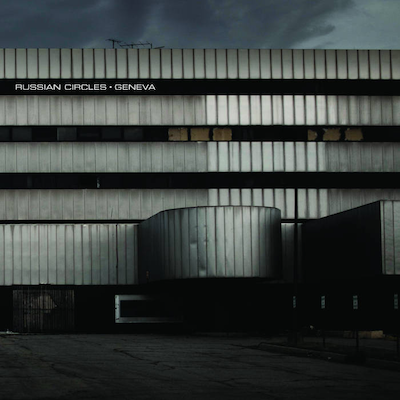
If you don’t have something nice to say, don’t say anything at all. Maybe the guys in Russian Circles were told that too many times by their moms. ‘Cause they’re certainly not the types to open their traps.
The Chicago cell is just about ready to introduce to the world the third Russian Circles record, Geneva – and like its predecessors, the heady adventure is vocal-free. Fortunately, though, we got guitarist Mike Sullivan to pipe up to us about the record.
Relaxed and genial, Sullivan quickly allayed our suspicions that social awkwardness might be behind Russian Circles’ speechless approach to heavy rock. We’re pretty sure he isn’t a hermit, even if he is in a band. Well, pretty sure.
“I play guitar a shit-ton,” he told the IndiePit Blog yesterday in a lengthy interview. “Day in and day out, there’s nothing else, really. Obviously I have other interests, but there’s nothing I spend as much time doing.”
It’s true, this is a guy who bleeds music. Like an ice sculptor, he and drummer Dave Turncrantz slave over the details of their songwriting, making sure they’re chiseling each song just right. Even if that means tearing down the thing and starting from scratch.
“It’s always better to go too far overboard and then pull ourselves back. Then you have more to work with,” he said. “But there’s something I like about not hiding behind too much stuff.”
But compared the past RC releases, there is a bit more going on over the course of Geneva, as fans will quickly notice when it drops October 20 release on Suicide Squeeze. They’ll hear again from These Arms Are Snakes’ Brian Cook, who has been playing the part of Russian Circles bassist for about a year now (and who recently contributed to the IndiePit Blog a beyond-cool top 500 songs list). And fans will also hear a couple of other, newly introduced musicians, chiming in: cellist Allison Chesley and violinist Susan Voelz.
Yeah, that’s right: We’re talking strings, homies. Like, the ones you need a bow to play with.
“They were awesome – they were completely professional,” Sullivan said about the local talent he recruited. “I feel bad – they just came in and took care of their parts right away. It couldn’t have been easier. And then there’s us, sitting there for way too long on one part.”
Anyone who’s heard Russian Circles should get a chuckle out of that. ‘Cause if there’s one overarching theme to their music, it’s almost certainly repetition. Repetition of a singular progression that slowly crescendoes, incorporates other compositional elements along the way and finally bursts open like a Cadbury Egg in your mouth. That, in essence, is the constitution of every Russian Circles track.
“A lot of the songs go through various transformations in the writing,” he said, delving into the makeup of Geneva. “They’ll start off on acoustic guitar, kind of in a classical sense, and then it’ll evolve into kind of a riff – and that’ll be more electric or distorted before you know it.”
Truer words could not be spoken of the new album, which masters that sustained, concentrated approach to melody. From what has been described so far, you might not think that would leave much room for experimentation. But that actually does play a role in the band and was integral to the construction of Geneva.
“We experimented with different amps and different rooms, different mics,” he said. “When it comes down to the arrangements and compositions of a piece, how it’s executed with the same intent, it’s kind of interesting to play with different instrumentation. A little bit of the melody is there – the same song structure – but you can interpret it differently. You augment something here. A song can definitely sound way different and take on a whole new life.”
And that can sometimes prove problematic too.
“It’s a total struggle on both ends, ’cause we like to say to ourselves, ‘We’re a three-piece rock band, let’s not overindulge anything.’ We’re always conscious of playing every song live, and to this point, we have so far.
“But on the other side, it’s like, well, if you can make the song as strong as possible, why wouldn’t you want to introduce different elements or take away this or [that]? It’s fun to explore.”
As Sullivan dug even deeper into the nitty-gritty of Geneva, it seemed only natural to ask him to dissect each album track in all its intricacies – after all, that’s the precisionist approach he takes to songwriting and recording. And it turned out that Sullivan was game for giving us a track-by-track examination of each song – like Pelican did for us a few weeks back.
So here are the seven songs you’ll find on the record, and what went into the making of each:
“Fathom“: 10 seconds under the five-minute mark, the opening track to Geneva might surprise fans who are prepared to zone out immediately to new Russian Circles epics.
“That was actually the last song written on the album,” Sullivan said. “It was finished pretty much a few weeks before recording, before we did a little tour. We were practicing, and we started working on a riff, a growing-type of riff, and the drum chorus on top of it. We liked that progression, so we jammed on it for a little bit. We just kept it nice and simple: didn’t over-think it, didn’t take it apart and try to reassemble it. We just left it open: raw, naked and with no funny business going on. And it ended up being a really strong song, and the result of that was because of extra editing. We’d kept in mind that’d be first for some reason – ’cause it’s short and to the point. It was kind of a last-minute thing, but we were happy with it in the end.”
“Geneva“: Only slightly longer than its predecessor, the album’s title track is the fiercest song on the record. It’s a classic #2 album song: punchy, at least relative to other Russian Circles material. “Geneva” – which features a downright gnarly bass solo from Cook – has actually been a work in progress since the band was touring behind its last release, Station. The guys kicked it around for so long that it wound up being a “recurring theme” – and thus the album’s title track.
“That was probably the first song we were working on” for Geneva, Sullivan said. “And that was just some riffs that Dave and I would go back and forth with, either in between working on other songs or during soundchecks. It’s just a recurring theme we kept doing. We toured a lot behind Station, and that recurring song kept evolving, practice by practice, and we kept fine-tuning small things. Before we knew it, we had a structure. … It’s fun to see how you mess with a song, but come back and restart it.”
“Melee“: And here’s where the strings come in. A low-key respite from the album’s first two blistering tracks, “Melee” gives the listener the chance to really start ruminating.
“It was all based on a two-chord part back and forth, on a balanced-string guitar,” Sullivan said about the evolution of the song. “And the strings, that’s always something we’ve wanted to do but we never had the time or the resources to do so before in the studio.”
“Hexed All“: Even mellower than the song before it, this tune is short, at less than four and a half minutes long. But the condolatory track gives you the sense that you’ve gotten to the heart of Geneva.
“That song was interesting because it was intentionally done without percussion initially,” Sullivan said. “It was just a really mellow, mellow song. Again, it was written on acoustic [guitar] and became more elaborate and evolved. Eventually, throughout the whole song, it had a changing guitar part on top of it – a counter-melody thing going on, and another guitar solo going on, on top of that.
“We actually liked it way more stripped down, with simple instrumentation. ‘Cause the [next] song, ‘Malko,’ is pretty intense and heavy and crams notes down your throat. So we thought we owed it to anybody who’s at that part of the record to give them a break. Let their ears chill out for a while.”
Look for the louder version of the song to “pop up at some point,” maybe on a Japanese release.
“When the Mountain Comes to Muhammad“: At last, a voice can be heard on Geneva – it’s just not a voice that belongs to anyone in the band. The song incorporates a mysterious audio sample, with Russian Circles’ trademark instrumentation, well, encircling it. Like “Malko,” the track also went through many incarnations – and found the band again having to rein in itself.
“That song took on many different versions and different song titles,” Sullivan said. “The song was totally wrapped up and finished. It was a completely different song – a lot faster, a lot shorter. But we kept checking it out in soundcheck, and playing it over and over and over again in that format.”
And something wasn’t right with it.
“So we got back from that tour and had a few weeks of recording. We sat down and restructured that, and it became way more mellow, which is just us messing around playing keyboard parts and a simple guitar part. And [on top of] that foundation, we were able to incorporate parts of the other version of the song.”
As for the title, which visibly deviates from the others:
“That was a Brian Cook-ism. The [song] titles all mean something to us in a personal way, but Brian was vibing on another idea. He was reading a book, and that’s something in the book that affected him, so he called the shots on that one. That’s what happens with Brian naming a song – they have more interesting titles than the monosyllabic bullshit Dave and I have.”
“Philos” (pronounced FEE-los): The album’s sprawling, haunting closing track will leave listeners feeling blissfully depleted, like coming down from a mountain after a daylong hike.
“That’s a song that we actually recorded the first time last summer, to do a split with These Arms Are Snakes,” Sullivan said. “And that was to be released on the European tour we did with them. That was done with [Electrical Audio’s] Greg Norman, the same guy who engineered Geneva, so that was essentially similar to what happened with ‘Fathom’: ‘Let’s not over-think this. Let’s record a song and not mess with it and see what happens.’
“When we redid it for the album, we kept a similar structure, we just added things – different instruments, especially the trombone and trumpet. We kept the same format, the same structure, just changed minor things here. We changed the time signature at one point. And then added piano here and there. Just a different treatment altogether, and it gave the song a whole new life.”
After spending countless hours honing Geneva to perfection – both on studio and during rehearsals while on past tours – Russian Circles will be logging more time preaching their new gospel to fans on a tour with the Isis-affiliated Red Sparowes. (The band’s MySpace page has the full itinerary.)
And speaking of preaching, we couldn’t let the interview go by without mentioning that, for a band that doesn’t have any lyrics, Sullivan sure has an awful lot to say. So does he or anyone else in the band have a temptation to finally stand up in front of the mic?
“Maybe with time, but we’ll stick to music,” he said. “We’ll offend somebody within seconds if we’re given too much time, so it’s for our own good. Self-censorship.”
Originally published on Indiepit.com in 2010.
 The Bad Penny (beta)
Leave a comment